




GRANITE SHOALS, Texas — Granite Shoals police chief John Ortis was dog tired by mid-afternoon on the Saturday of the Texas High School Barbecue State Championships.
The heat – and the fact that he’d been at Quarry Park since 3:15 a.m. to set up the event – was only half the story. Three days ago, this entire place was underwater after three days of torrential rain. As a city, Granite Shoals had shut down and banded together to tend to Code Red: saving the BBQ State Championships. Roads were blocked off because the street crews were using asphalt-digging equipment to turn Quarry Park’s dirt over and let the water drain out. Fire Chief Tim Campbell coordinated the audio and electrical equipment for a new PA system. City councilmembers like Steve Hougen and Judy Salvaggio stepped in as two of 175 volunteer judges to cover for out-of-towners who couldn’t make it.
From the outside looking in, it seems like there were so many reasons to just cancel. Quarry Park is hosting the Howdy Roo BBQ next week, and the three-day Granite Fest music concert the week after. Why not just throw in the towel – or napkin – and live to fight another weekend? After all, the city doesn’t take a host fee.
Honestly, all the work won’t make sense to you for a couple more hours. Not until you stand beside Chuck Schoenfeld, the president of High School BBQ Inc., as he emcees the award ceremony. Schoenfeld and his wife, Marnie, serve on the board with other founding members Russell Woodward, Marcus McMellon, and Jan Elliott. They've since added Alec Knight and Jerry McPherson as the event has expanded to 92 high schools from across the state of Texas. With five cooks per team, combined with parents and friends supporting each, at least 1,000 people are hanging on Schoenfeld’s word. Only at that moment will you realize that canceling this event was never in the cards.
“When you stand down there, looking back this way, it’s a sea of people you would not believe,” Ortis said.
The Texas high school state championships in football and basketball are undoubtedly a spectacle. Take a time-lapse video over three days, and you’ll see cowboys from a town of 200 people be replaced by blue-collar trade workers from a tight-knit community who are then replaced by financial analysts from the biggest metro areas. But nowhere else do you see all those people in the same park at the same time. Texas is one of the most diverse states in the country. A road trip in the northeast that would take you through four states wouldn’t even cover half of Texas. But your eyes could span over the entire state standing under the awning at Quarry Park. Class 6A Southlake Carroll’s barbecue pit was next to Class 2A Nocona’s. The Lancaster contingent from South Dallas pulled up lawn chairs beside Laredo ISD students and parents. Three schools that would normally never cross paths – North Texas Prosper Walnut Grove, Central Texas Giddings, and South Texas Laredo Nixon – all tied for second place.
Everyone had the same task to prepare five dishes: dessert, barbecue beans, chicken, ribs, and brisket. But they all had different ways of inheriting their recipes and love of the sport.
Some, like state champion-alumnus Dylan Dodd, hardly knew how to cook ramen noodles before he started culinary classes at Reagan County High School. Now a football player at Wayland Baptist, he’s majoring in chemistry and minoring in cell biology, thanks in large part to the interest sparked by competing at the state level.
“Anytime there’s a get-together – a pre-season cookout or a post-spring ball cookout – I’ve become the cook. It’s such an awesome skill that I got from (State BBQ),” Dodd said.
Others, like Somerset all-state offensive lineman Jake Seay, were born into barbecue through their family business. Seay is one of three football linemen on Somerset’s barbecue team. Somerset agriculture science teacher Cody Riojas started the group at his alma mater after seeing how it could help kids find a career - or simply a new life skill - while teaching at Cotulla. But even he never would’ve guessed that football players like Seay would give as much effort in the pit as they did on the field.
“Jake is very blessed,” Riojas said. “He’s been able to visit other colleges and see where his future might be as far as football. The fact that we’re able to combine the two has been the coolest thing on earth. If you would’ve told me I’d have football players this involved in meat science and barbecue, I’d have been like, ‘Nah, I went to school here!’”
And then there are those who followed in their siblings’ footsteps, like Laredo Nixon quarterback Mauricio Lugo. He originally got into barbecue because it reminded him of his family cookouts. Lugo realized he’d found a new family by the time he reached his first state championship at Granite Shoals.
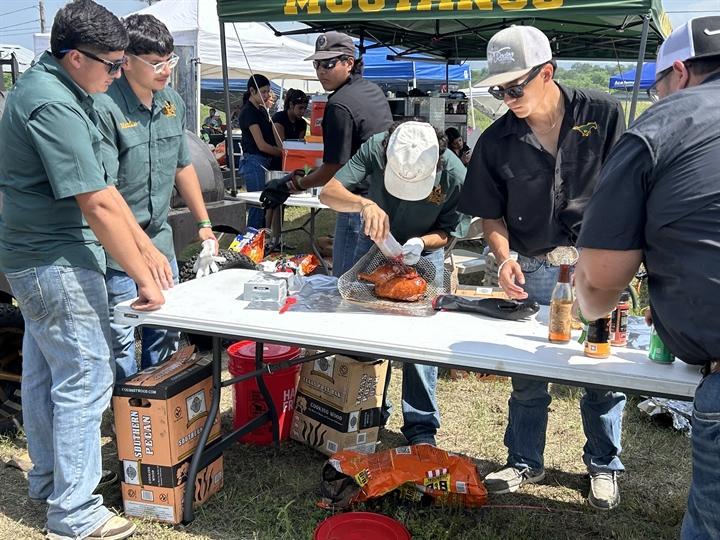
That’s why Granite Shoals Police Chief Ortis and Fire Chief Campbell, along with the Schoenfelds and the rest of the city, worked so hard to put this event on. Ortis is from Atlanta, Georgia, where his barbecue knowledge consisted entirely of pulled pork. That is, until Campbell asked him to join the Lone Star Barbecue Society cook-off competitions. Over 20 years, the pair learned more about building relationships than about trimming a perfect brisket. They want the next group to have the same experience.
“Chuck (Ortis) and I have been in the competition cook-offs for years,” Campbell said. “Everybody’s getting older, and you kind of see them start fading away. To start a new, younger generation into the barbecue competition so you can see it continuing on, that’s important.”
Because somewhere in the fog of smoke, the blueprint for how to lead a better life becomes a whole lot clearer.
Barbecue takes discipline. The contestants’ alarms blared at 3:30 a.m. Saturday morning. The park gates opened at 4:30 a.m. and the pits fired up at 5:00 a.m. in order to have the brisket ready to serve by 3:00 p.m. Riojas, the Somerset coach, says 30 kids come out for the barbecue team every year. But after two mock runs, that group is whittled down to two teams of five. Riojas’s entire team was at Quarry Park before dawn despite Somerset’s high school prom the night before.
“That’s when we see who’s really serious about it,” Riojas said. “If you’re not going to come out to that early morning practice, you’re not going to wake up in a hotel when mom and dad aren’t there to get you up.”
Barbecue – in this format – is also much different than your uncle manning the grill and not letting you even look at it. In recent years, permanent hosts like Dodd at Wayland Baptist have shifted to pellet grills. These smokers have exploded in popularity because you can press three buttons and the grill will maintain a constant temperature for hours, almost like an oven. They’re awesome – and they’re also banned at competitions. Teams could only use a barrel drum with charcoal or a stick burner where wood is placed in a firebox that heats the grill. Pitmasters must maintain a constant temperature by making minute adjustments to the vents, letting air oxygenate the fire, or choking it. You find out what you're made of in that fire.
“It’s so hard to host and run a stick burner,” Dodd said. “You turn around, and the fire is dead. Then you turn around, and it’s at 300 degrees. Then you look up, and it’s like, ‘Crap, I’ve got to go split wood.’ And then you can’t hang out."
Barbecue requires a calm head and decisive action to overcome adversity. It’s a simple art. Trim the meat, place it in the smoker, and maintain a constant temperature for a low-and-slow cook. But there’s a million things that can – and will – go wrong. In one of their pre-state meets, Somerset’s temperature gauge stopped working, and the smoker was running 100 degrees hotter than it should, scorching the brisket. The team had to switch temperature gauges from an unused smoker, then work backward by cooking at a far lower temperature than normal, which could’ve thrown all the timing off.
That’s where Lugo’s quarterbacking experience comes in handy. During the Friday Night Lights, defensive linemen come out of nowhere to sack him. But on the Saturday Afternoon Smoke, it’s the wind that picks up unexpectedly and fuels a hotter fire than you want. At Lugo’s first state meet, he placed 4th out of 92 schools in ribs.
“Just like in football, you’ve got to be calm,” Lugo said. “Read your keys and let it happen. You’ve got to fall back on what you’ve done all the time. You can’t be doing everything on the fly.”
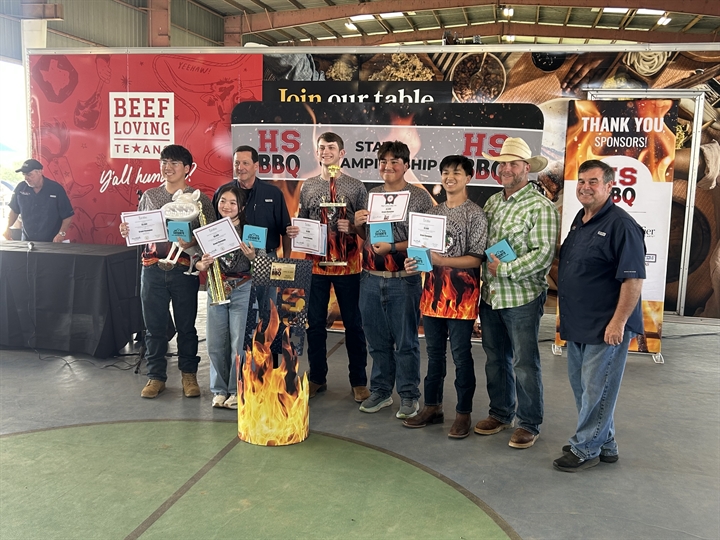
But most of all, teamwork is required in the pit. Most cooks, especially for brisket, start the night before. But due to logistics, the state championships start at 5:00 a.m. and end at 3:00 p.m. when the brisket is served. Those 10 hours seem like a marathon, but it’s an all-out sprint.
Teams usually have one student take command of each food category because everything needs to be prepped simultaneously. Since everyone is on the clock, nobody can be micromanaged. There must be ultimate trust, especially when all the different meats go on the same grill. The chicken, ribs, and brisket all have different serving times, so they must be rotated in the smoker to ensure none cook too fast or too slow. While someone is watching that temperature gauge like a hawk, the others must be cleaning the prep area, getting the knives ready, or simply retrieving snacks and water.
“When you’re working around here, you don’t have four arms,” Prosper Walnut Grove junior Graceton Choate said. “So you’ve gotta always have someone with you, like, ‘Hey, can you open my drum for me?’ Or, ‘Hey, can you wipe this grate down?’”
For most extracurriculars, that workflow could be honed during the athletic period, band period, or robotics class. But the time requirement of barbecue means it can only be practiced on the weekend, normally through cook-off fundraisers. Brett Claypoole, the culinary arts teacher at Prosper Walnut Grove, gives his team racks of ribs to practice at home.
“They get to eat their homework," Claypoole said. "It’s a hard thing, but somebody’s got to do it.”
And just like the State BBQ Meet showcased the diverse regions of Texas, there’s a ton of diversity in interests within each school’s team. In larger schools like the soon-to-be Class 6A Prosper Walnut Grove, most of these kids could’ve gone through high school not knowing each other had they not been on the same barbecue team. Now Choate, who used to define himself as a football player, will return to cheer on the barbecue team at state once he's in college just like he goes back to a football game.
Lugo thought most about the community he’d found as he drove back to Laredo on the team bus. Originally, he’d been hesitant to join the barbecue team as the only football player. His fourth place trophy in ribs seated securely next to him was only part of the reason he knew he’d made the best decision. Sure, he was excited to show the hardware to his friends and family. But, more importantly, he couldn’t wait to tell them about this one-of-a-kind event, and the bonds he’d formed because of it.
“People that I didn’t talk to, now they’re going to be my lifelong friends,” Lugo said.
This article is available to our Digital Subscribers.
Click "Subscribe Now" to see a list of subscription offers.
Already a Subscriber? Sign In to access this content.
 Don't Miss Any Exclusive Coverage!