




The anniversary of February 27 has haunted Corey Wilson for 17 years.
The countdown begins in the middle of the month, each passing day zapping his confidence more and more as he hurtles toward the day that changed his entire life. His radiant smile disappears. The jokes are no longer on the tip of his tongue. He’s drawn further and further inward, all his energy consumed waging war inside his mind.
His family stopped asking him what was wrong a while ago. They know what’s wrong; they’ve always known what’s wrong. But they also know they can’t take Corey out of this wheelchair and make him walk again. They cannot change the events of February 27, 2009, when a car trying to merge into Corey’s lane on I-35 clipped the back of his Chevy Trailblazer, fishtailing, then rolling it over, and ejecting him 45 feet, paralyzing him from the waist down, and ending his football career before he was ready. It’s no longer healthy to live in that moment, and all the ‘what ifs’ that came after.
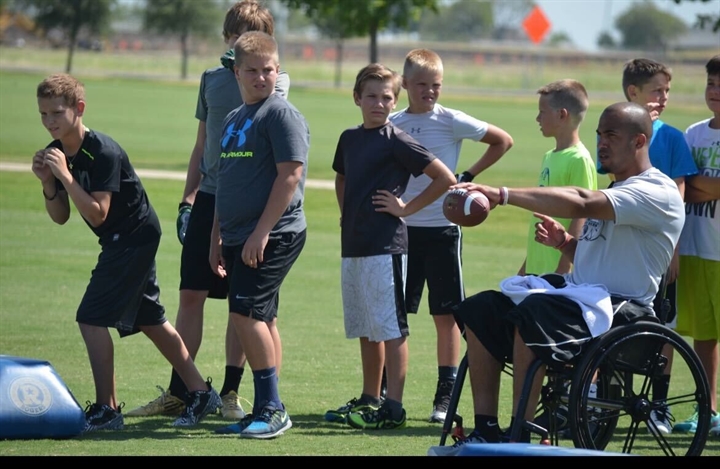
But this year’s February 27 was different. Corey is spending the spring semester as a substitute teacher at Frisco Panther Creek High School, where his youngest brother, Ryan, is the team’s defensive coordinator. He’s working on an online alternative certification so he can become a full-time teacher and a football coach.
For a long time, Corey resisted the call to coach. Maybe it was because both his brothers, Travis and Ryan, are football coaches, and his entire life as one of three brothers who played Division I football has been a quest to differentiate himself. But the more he hangs around Panther Creek’s offseason program, the more he realizes Travis was right when he said coaches get too caught up in thinking about what they can do for kids. They need to think more about all these kids can do for you.
“If I was sitting at home on that day, it would’ve been a horrible day,” Corey said. “But I was able to be their after-school workouts and encourage and challenge guys.”
This is not the first time Corey has tried coaching. He spent two years on staff at Dallas Parish Episcopal with Travis and coached the freshman and JV 7-on-7 teams when Ryan was at Frisco Independence. But he’s never fully committed like this. Sitting on the sidelines is painful. What hurts him most is not that he cannot run around and catch jump balls anymore. It’s that he took it all for granted when he could.
“There was a lot of regret and beating yourself up over the fact you didn't always take everything seriously and work as hard as you needed to every day,” Corey said.
Confidence is at the core of Corey’s being. And, like so much of who he is, that confidence was a conscious choice meant to create his own identity outside of being Travis Wilson’s younger brother. How could he be different from Travis when they both played wide receiver, both wore No. 4, and both attended the University of Oklahoma? He had to walk the line between following his brother’s footsteps and carving his own path. So he modeled his game after players like Chad Ochocinco and Terrell Owens, players whose bravado made as many headlines as their play. He earned the childhood nickname ‘Superman’ and got it tattooed on his chest. But not the logo like everyone else gets, of course. His ink was Superman busting through a billboard. Different.
Corey was always a phenomenal athlete. He earned second-team honors on the 2006 Dave Campbell’s Super Team, despite playing wide receiver on a Wing-T Carrollton Creekview team. But he was also an incredible headache to coach. Selfish. Negative. When he got to Oklahoma, where everyone was just as talented, his attitude got exposed.
After redshirting his first year, Corey wanted to switch his jersey number to 4. All of the Wilson brothers had worn 4 at Carrollton Creekview, representing their ‘4 Strong’ family of three sons and their mother, Wendy. Travis had donned the 4 jersey at Oklahoma, where he finished his career second in program history with 17 touchdown receptions. After graduating, he’d passed it down to Malcolm Kelly. Kelly promised Corey he’d pass it down to him, too. Except there was another big-time recruit who wanted that jersey. The coaches allowed both players to wear it through two-a-days, seeing who would earn it. Corey didn’t.
Losing the number woke Corey up. He told legendary OU strength coach Jerry Schmidt he wanted to get stronger, so he began doubling up on workouts, first with the wide receivers, then the defensive backs. As a redshirt freshman, he was the model scout team player, serving as the practice version of stars like Texas Tech’s Michael Crabtree, Oklahoma State’s Dez Bryant, and Florida’s Percy Harvin. But every now and then, that ego inside would erupt, demanding to be catered to like it was in high school.
That February, Schmidt booted Corey from a winter conditioning workout for poor attitude. Corey usually deflected blame when this happened. But for some reason, this ass chewing stuck with him. Spring football was a week away. He was set to be a redshirt sophomore and was still making freshman mistakes. He stopped Schmidt’s car as he pulled out of the parking garage, saying he wanted to come in on Friday for extra work to make things right. Then, he called his mom. If he didn’t shape up, he told her, he was about to miss out on the best thing that ever happened to him.
“That was on Wednesday, when he called me,” Wendy said. “Friday, he had the accident.”
There was a blown-up picture of Corey catching a pass in warm-ups across from his hospital bed. He’s thankful for the supporters who placed it there, and he understands the thought process. But that picture taunted him, too. It forced him to remember all he could once do, and reckon with what he couldn’t do now. But Corey decided to use that photo as motivation to attack his rehab like he would’ve attacked spring football practice. Two days after the accident, lying in bed, he’d told Travis he would walk across the field during the last home game of the following season.
In Corey’s mind, he’d concocted an ESPN-worthy, and physically impossible, moment of running onto the field, leading his team out of the tunnel. After months of grueling rehab, 15 steps with a walker was all he could manage. But it was 15 more steps than anyone else could’ve taken. Travis swears it was the loudest ovation he’d ever heard at Gaylord Family-Oklahoma Memorial Stadium. Standing at midfield, Corey heard the cheer he’d craved ever since he saw Travis score his first college touchdown. In that moment, you could’ve told him he’d made a 50-yard touchdown catch.
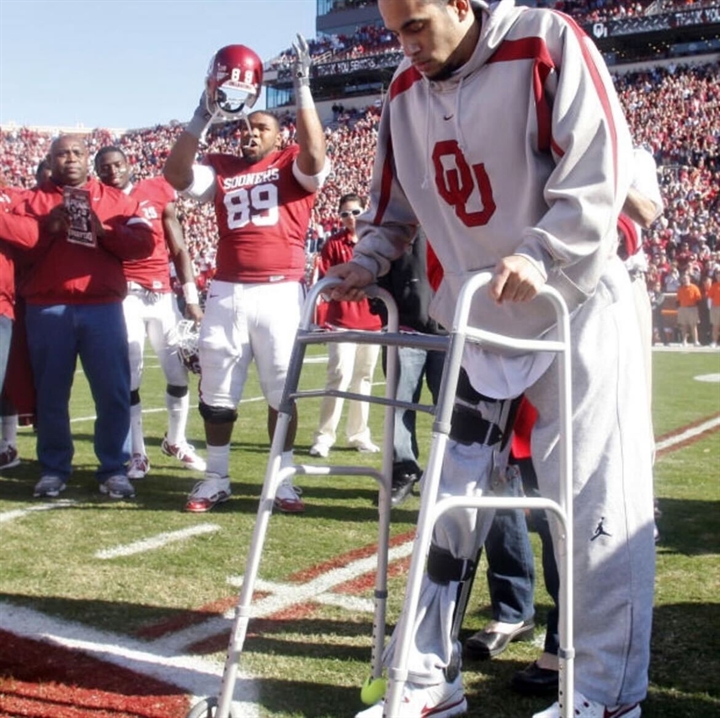
“That’s one of the toughest people I’ve been around,” Travis said. “To make that statement and then make it a reality and do it in front of those people, that shit was incredible.”
“I couldn’t tell if I wanted to cry or put on a helmet and run through somebody’s face,” Ryan said.
But that high only lasted so long, and Corey thought he couldn’t reach it again through coaching. He needed closure on the college athletics career that never was. So he went to UT-Arlington to get his master’s degree and joined the Movin’ Mavs wheelchair basketball team, dedicating himself to that sport as hard as he should’ve dedicated himself to college football. UT-Arlington won back-to-back national championships in 2021 and 2022. Raising those trophies allowed Corey to end his athletic career on his own terms. But it also allowed him to realize those trophies were never what he was actually seeking. They were nice, but they did not fulfill him. And that led to the ultimate question: What would?
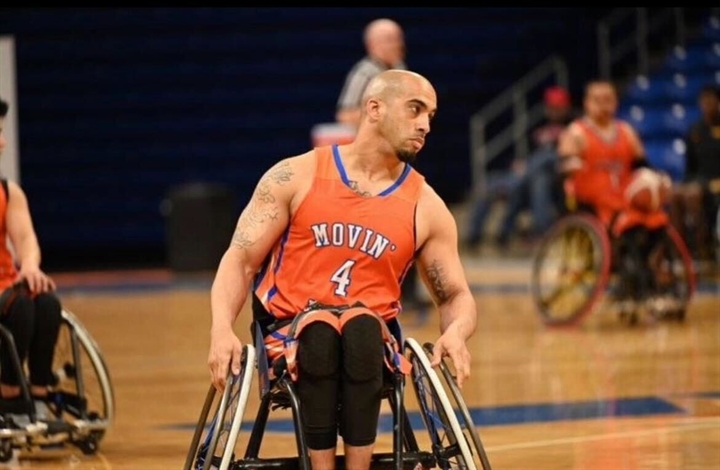
He might have found his answer as a substitute teacher in Frisco Panther Creek’s classrooms.
This past fall, Corey was substituting for a class that the freshman football team’s quarterback and wide receiver were in. Corey sees glimpses of himself in this wide receiver - both the talent and occasional immaturity. That day, the quarterback and wide receiver were cutting up in the back of class. They were antsy for that night’s game, both proudly repping their Frisco Panther Creek team shirt. Once class ended, Corey called them to his desk.
“Y’all realize what shirts you have on?” Corey asked.
The boys glanced at their chest, then each other, then locked their eyes on him.
“Let’s make sure we’re representing it the right way,” Corey said.
Both of them nodded, but otherwise didn’t respond. Corey knew they heard him, but he didn’t know if they knew how to respond.
He got his answer a couple of weeks ago. Corey was watching the Frisco Panther Creek players compete in one-on-one drills after practice. That same wide receiver beat the defensive back on a post pattern but dropped the ball, flashing all of his potential and his lack of focus in one play.
“That’s 10 for the drop!” Corey shouted, reminding the player to do the 10 pushups the team required for dropped passes.
The kid looked at him and kept jogging to the line. He must’ve traveled 25 yards, but it felt like the longest 25-yard trot ever in Corey’s mind. The truth was, it had terrified him to coach the kid like that. Part of the reason he’s been so reluctant to coach all these years is that he was scared a kid would look at his wheelchair and think Corey didn’t belong there. Corey never saw a man in a wheelchair in his locker rooms growing up. Deep down, he’s scared of how he would’ve responded to one, and he was scared that this kid was about to respond the same way.
The freshman’s voice snapped him out of his trance. When Corey looked over, the kid was waving and pointing at him, getting his attention so Corey could watch him crank out 10 pushups. He’d just stopped a kid from going in the same wrong direction he’d once walked. This was the purpose he’d been searching for every day since the accident.
“All the struggles and tears I went through with the game being taken away from me, being able to pour that into them is incredible,” Corey said. “Once you get a kid to realize that this is coming from a good place and this is something I can follow, I think that provides more meaning than any catch or highlight could’ve ever brought.”
This interaction could’ve taken place in an alternate universe where Corey doesn’t get in a car accident and lose his ability to walk. But would his words have the same impact if they didn’t have the experience behind them, and the urgency it creates in his voice? No one can sense a fraud like high school boys, maybe because they’re all acting like someone else, too, until they find out who they really are. But they know Corey isn’t playing a character: they’re getting the real him. Uncut and raw, with all the mistakes and the ego and everything he’s overcome included.
When he was their age, Corey played a character, too. He tried telling everybody he was Superman, getting the tattoo to prove it. But it wasn’t until he lost his ability to walk that he truly gained the moniker he always wanted.
“‘Superman the Boss’ was his alter-ego,” Ryan said. “After the accident, it was actually like, ‘Dog, you are Superman, the way you overcame this thing.’”
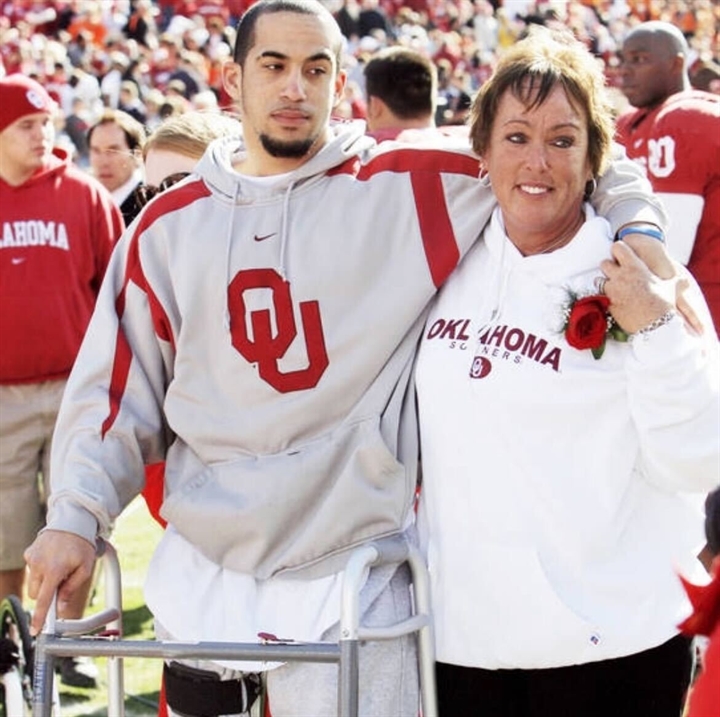
But it wasn’t just that he overcame the paralysis; it was how he did so. When his Oklahoma coach Bob Stoops, his teammates, or his high school coaches visited, Corey would prepare with jokes to lighten the mood. Even in his weakest moment, he was devising how to be strong for others. His smile became his Superman cape.
Early in the rehab process, Corey recognized that many of the people who helped or reached out to him did so because of his status as an OU football player. So he has used that platform to help those who don’t have it. He and Travis founded Good or Great, LLC, named after a quote Travis heard during his time in the NFL, which he applied to Corey’s training every time he thought he couldn’t do another rep: ‘Do you want to be good or great?’ He also started the ‘Find a Way’ foundation, based on one of his Oklahoma strength coaches favorite words of encouragement during a summer workout. How he hated hearing that during the dog days of summer, and how he longed to hear that again. Corey even started a charity basketball game at the University of Oklahoma, worked with the Miracle League foundation at UT-Arlington, and gave speeches for a non-profit character development program called Ethos Education.
Corey had spent his entire life trying to be different from his brothers. But by his actions, his brothers have tried to become more like him.
“Knowing that my brother was not going to be able to walk or play again, it really changed my mentality to make every day and every moment something special,” Ryan said. “To be grateful no matter how much of a load you’re carrying. Be grateful for every little thing, from stepping out of bed to saying hello to your loved ones.”
Corey’s brothers pushed him into coaching because they knew he could have the same impact on a generation of kids as he did on them. Texas high school football programs like Frisco Panther Creek and Prosper are too large for real life not to graze them. Having Corey on staff will give all those kids an example of how to respond.
“There are plenty of tragedies that happen throughout a football season when you’ve got a family that big,” Travis said. “Something is going to happen to somebody. We lost other teammates to injury. Everyone is going to face adversity, but how do you handle it?”
Corey Wilson never imagined his life in football would look like this. But watching this freshman take accountability for his mistake, finish his 10 pushups, and then go fix it, energizes him more than catching a touchdown ever did.
“I can’t say I’ve ever felt as much purpose and as alive as I do when I’m around the football guys,” Corey said.
This article is available to our Digital Subscribers.
Click "Subscribe Now" to see a list of subscription offers.
Already a Subscriber? Sign In to access this content.
 Don't Miss Any Exclusive Coverage!