



There’s not a whole lot to Rotan, Texas.
If you’ve ever found yourself driving to or from Lubbock or Abilene, there’s a chance you drove through the “Genuine Texas Town” of just over 1,200 people at the intersection of State Highways 70 and 92 and didn’t even know it.
That inconspicuous charm was precisely why Sammy Baugh, unquestionably one of the greatest football players to ever live, couldn’t get back there fast enough after his illustrious career ended, retiring to his family’s 7,600-acre ranch between Rotan and Aspermont.
That’s where his son, David Baugh, resides today with his wife, Jean. David, one of Sam’s five children (four sons), caught the pigskin bug at a young age and went on to coach high school ball for 34 years.
Like his father, he high-tailed it back to Rotan after retiring in 2000.
“I had my life planned out when I was in high school – I wanted to be a coach and then I wanted to run this ranch, and all of that has come about,” said David, now 82 years old.
It’s really the Baugh way. For as much prestige as that last name carries in Texas and across the country in football-loving households, the Baughs, at their core, are just hard-working, small-town folk who could go without the spotlight that comes with being related to the Hall of Fame quarterback.
Growing up, David knew of his dad’s popularity but didn’t really put it into perspective until he was much older.
“When I was a small boy, I knew he was somebody important,” he said. “But he was more like a regular dad. All my life we lived out here on the ranch and we did more ranch stuff than we did football stuff. He was an influence in that manner. When I got older and more knowledgeable, I realized how good he really was.”
Just how good was he? Oh, where to begin. After a decorated high school career in Sweetwater, Sammy threw for 39 touchdowns in three seasons at TCU and led the Frogs to wins over LSU in the Sugar Bowl and over Marquette in the inaugural Cotton Bowl. He finished fourth in the 1936 Heisman Trophy voting and was a two-time All-American.
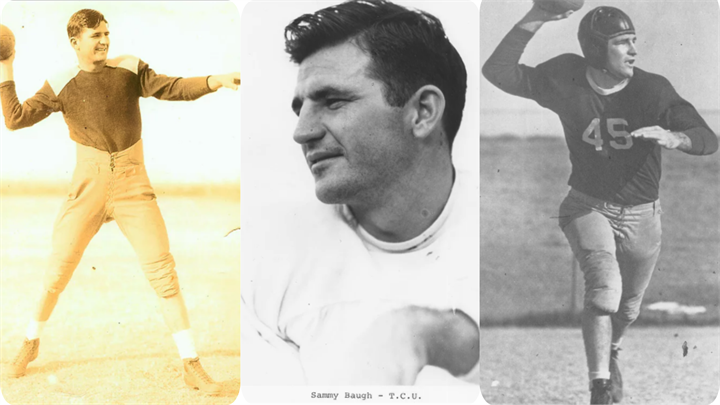
After Fort Worth, Sammy went on to Washington where he not only became one of the Redskins’ all-time greats but helped revolutionize the game. Before Baugh got to the nation’s capital, the passing game was still a relatively limited part of most offenses. 'Slingin' Sammy helped show how devastating it could be.
He threw for over 21,000 yards and set 13 NFL records at three positions, becoming a charter member of the Pro Football Hall of Fame and being named to the NFL’s 75th and 100th Anniversary Teams.
He also accomplished something that will never happen again – he led the league in passing, punting and interceptions in 1943. Ponder on that for a second.
“In one game he threw four touchdown passes and in the same game he intercepted four passes,” David said. “In the same game. Of course, he also did the punting.
“All your great quarterbacks today, they couldn’t match what he could do. When he played defense, he was back there as a free safety. He knew the passing game better than anybody, so he pretty well figured out where he needed to be to intercept the ball.”
As great of a football player as he was - the nation’s top college passer is awarded the Sammy Baugh Trophy each season – David said his dad probably liked baseball more than football.
“At one time he was in the Cardinals organization and the player he had to beat out was Marty Marion, who was a Hall of Fame-level baseball player,” David said. “Sam said, ‘I realized after a short period of time that I wasn’t going to play ahead of Marion (they were both shortstops)’ so he didn’t pursue baseball as much.”
Be it football, baseball, or even calf roping, Sammy Baugh was simply David’s dad at the end of the day. The memories of his dad away from the spotlight are the ones he holds closest to his heart.
“We did more with our dad working out here on the ranch than we ever did any type of athletics,” David said. “When we were little, we did Little League baseball, junior high football, basketball, track and all that. Sam was a calf roper, and we’d always make a deal with him – he always wanted us to turn down his calves for him, and we always wanted him to pitch us batting practice. We’d trade out. We’d rassle those calves for him so he could rope them and he’d come pitch batting practice for us. That was a cool deal. I realized how unique that was later on.”
--
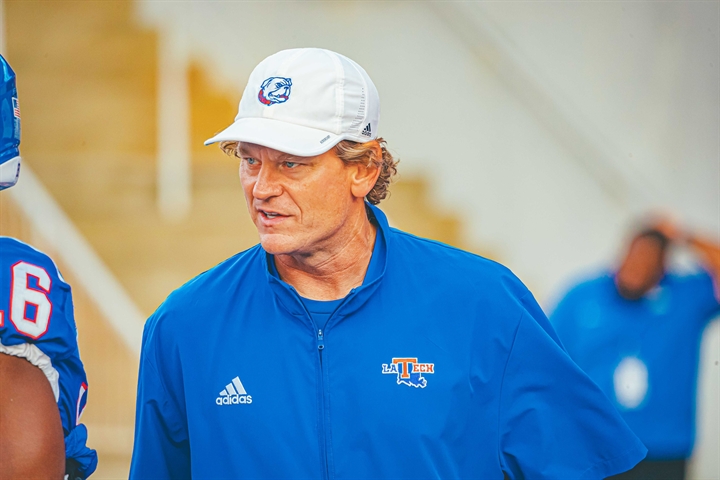
Sonny Cumbie fights back tears at the mere mention of David Baugh, his head football coach at Snyder High School where he graduated in 2000.
“I just think so much about Coach Baugh,” said Cumbie, who is entering his fifth season as Louisiana Tech’s head coach. “I’m passionate about the game of football and passionate about this profession. I was fortunate in high school to be under someone who guided you the right way and inspired you to want to go on and do this.”
Cumbie can close his eyes and picture the diesel-burnt yard marks on the Snyder High practice field with Coach Baugh throwing slant routes right along with him.
“He’s wearing his Russell Athletic shorts, his coaching polo tucked in to his shorts, his cowboy hat, Bill Dance sunglasses on and just throwing slants with me, throwing verticals,” Cumbie said. “I still remember in my mind, whatever he’s doing I want to do because this looks like a lot of fun.”
That was part of David Baugh’s charm, the way he made players like Cumbie feel. Whether it was going over to coach’s house after Friday home games to eat Subway sandwiches and wait to see whether they made the highlight shows in Lubbock or Abilene. Or the anticipation the following Tuesday of homemade ice cream the coach’s wives would make after a win instead of store-bought popsicles they’d receive after a loss.
“I wanted to coach because of how I was coached,” Cumbie said. “I loved how they made me feel, how they challenged me, the camaraderie of the whole staff, and it was all spearheaded by Coach Baugh because it comes from the top. That’s why I coach.”
Cumbie still calls his old coach from time to time just to check in. He’ll never forget the time he called back in 2021 when he was Texas Tech’s offensive coordinator.
“I called to check up on him and Jean answered,” Cumbie said. “I asked her if I could talk to Coach Baugh and she said ‘OK, let me go get him. He’s on the back porch dove hunting.’ ‘DAVID!’”
Cumbie has a treasure chest full of those memories of his dear friend, his mentor, who has followed in his father’s footsteps by playing a lot of golf in retirement.
“When I talked to him about golf, he said, ‘Yeah, we go to The Masters, which is in Rotan, we go to Pebble Beach, which is in Aspermont, and then he named some other small town that they call the US Open,’” Cumbie laughed. “He sounds great.”
--
Golf became such an integral part of Sammy’s life after football that he would drive the 30-or-so miles to Snyder three or four times a week to sharpen his game. That course – a 9-hole facility on the campus of Western Texas College – is now named The Sammy Baugh Golf Course.
It was where locals like Cumbie knew they could catch a glimpse of the legend every Tuesday or Wednesday.
“It was like, hey if you wanted to be around Sammy, that was the time to do it,” Cumbie said. “I was able to be around him a few times.”
Sammy welcomed the company. He always made time for any and everyone around Rotan.
“He was the same person as he always was,” David said. “A newspaper man once spent time with him and he said he was the most common, uncommon man he’d ever met. Sam low-keyed all the accolades and things everyone praised him about.”
Sammy Baugh passed away in 2008 at the age of 94. His saddle and chaps were draped over his coffin outside the First Baptist Church in Rotan where he’s buried.
“I think he’d rather be a rancher than a great football player,” David said. “In fact, on his tombstone it says ‘Pretty Good Cow Man.’”
Cumbie recalls talking with David shortly after his dad’s passing.
“We were talking and he said, ‘You know everybody would talk to me about my dad as a football player and I finally went back and was re-watching some of his games,” Cumbie said. “He was a pretty good player wasn’t he?’”
He sure was, David. Your dad was simply the best. But so are you.
This article is available to our Digital Subscribers.
Click "Subscribe Now" to see a list of subscription offers.
Already a Subscriber? Sign In to access this content.
 Don't Miss Any Exclusive Coverage!