




Any teeth the NCAA had remaining to enforce rules onto the sports it governs were firmly knocked out of its mouth by a district court judge in Lubbock who granted an injunction allowing quarterback Brendan Sorsby to play in 2026 despite admitting to betting on his own team at Indiana and on other college sports at multiple stops in his college career.
It was a great ruling for Texas Tech, who now gets a star quarterback back in Week 3 in time for the Big 12 opener against Houston. The Red Raiders believe they’re a national championship contender with Sorsby under center.
But the ruling was bad news for everyone else. The implications of this are far-ranging. If the NCAA can’t enforce the most universal rule in sports – that gambling on your own team’s outcome is off limits – then what can it enforce? And if it can’t enforce rules, why does it exist? If the SEC and Big Ten were looking for a reason to break away and form their own league, this is the perfect excuse. And if Congress needed any reason to come together and push through a bill to provide anti-trust exemptions, this is the time.
The judge ruled that the NCAA would be harming Sorsby by not allowing him to play because he’s an addict and that the structure of being part of a team will benefit him. And while I have great empathy for addiction, it is not a hall pass to break rules. An alcoholic can’t cry addiction to get out of a DWI. A thief can’t argue in court that giving back the stolen items will cause him harm.
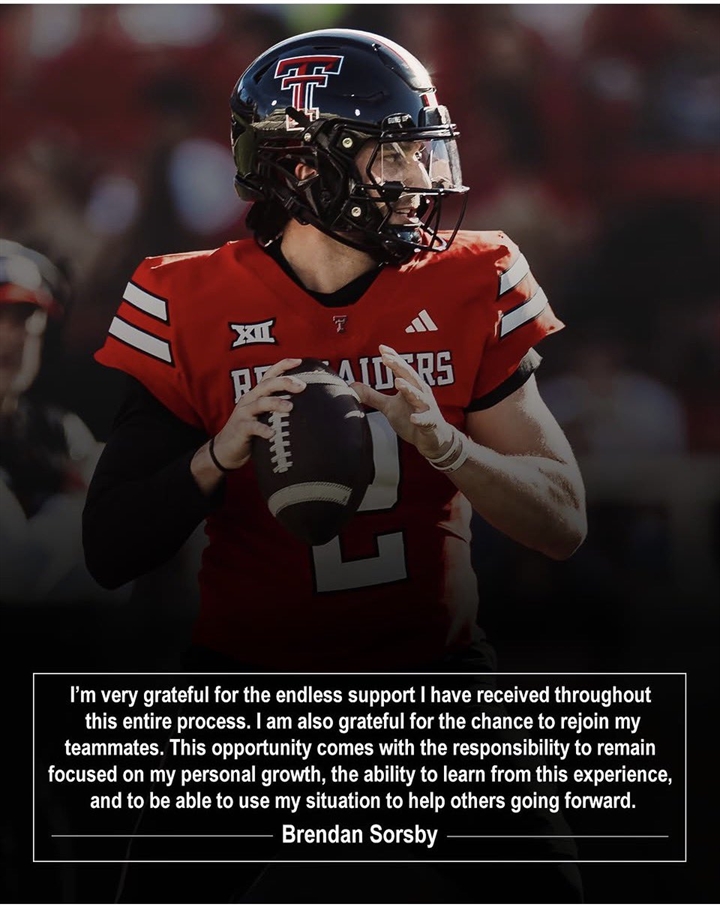
Sorsby wagered on college sports, including his own team. He used friends and family to bet out of state and admits to placing bets under age. This isn’t an argument for a seventh year of eligibility or for unlimited transfers or NIL rights. This was about the integrity of the sport, and an uneasy truce between gambling sites and player rights. This verdict drives home something we’ve all known – the NCAA is cooked.
Texas Tech has been unfairly maligned as a renegade program that’s skirted the rules and used an unregulated market to climb into national relevance on the football field and the softball diamond. But by backing and potentially playing someone who admits to breaking multiple NCAA rules, the Red Raiders can no longer deny those allegations. They are the renegade program that other fan bases accuse them of. They might not care, and that’s fine, but it is no less true.
Texas Tech will argue that the die was already cast. That the bluebloods in the SEC and Big Ten are already looking down their noses at the Red Raiders – and every other program outside those power conferences. That the only way to be invited into the next round of realignment – and a potential Super League – is to win and win big. And Sorsby allows them a higher ceiling, especially with Will Hammond still recovering from an injury.
Maybe they’re right. But if you’re breaking away from your neighborhood HOA to form a new one, do you invite the house on the street that bucked the rules to this extent? Does turning over the apple cart make Texas Tech more or less likely to get an invite into the next version of college sports? That’s something to monitor down the line.
Betting on college football isn’t as morally reprehensible as hitting your girlfriend or driving drunk or going 120 miles per hour in a 45-mile zone, and we’ve seen loads of players who did those things play on Saturdays without much punishment. I get the arguments that what Sorsby did pales in comparison to some of the transgressions we allow in coaches and players in almost every sport.
But the NCAA isn’t in charge of morality. In theory, it’s in charge of protecting the integrity of the game. The reason we love sports is because the outcome is undetermined and we believe that every player and coach on the field wants to win for team and personal glory. That goes up in smoke when we’re not sure if the participants have a monetary stake in the outcome. Maybe Sorsby never bet against his own team, but maybe the next player who does this does.
It’ll be impossible to know and that’s the issue. The district judge in Lubbock essentially ruled that players can do whatever they want and that the NCAA has no jurisdiction to punish those acts. It is a black eye for the sport but there might be a silver lining. Collective bargaining is the only way to fix the ills of college athletics and this type of decision might be the fulcrum moment that the powers-to-be needed to push that agenda.
College sports do need saving. The Sorsby ruling puts an exclamation point on that fact. It also puts Texas Tech squarely in the crosshairs. Every press conference will start with a Sorsby question. Big 12 media days will be a circus. All eyes will be on the Red Raiders in Week 3 against Houston. And the College Football Playoff committee could dish out its own brand of punishment by grading Texas Tech more harshly for any hiccups.
The Red Raiders weren’t the boogeymen that rivals wanted them to be. Until now. There’s an argument to be made that it will be worth it if Texas Tech plays for a national championship. And that all Texas Tech is doing is exploiting a loophole and that the fault should lie with the NCAA, not the Red Raiders.
But that will fall on deaf ears outside of West Texas.
This article is available to our Digital Subscribers.
Click "Subscribe Now" to see a list of subscription offers.
Already a Subscriber? Sign In to access this content.
 Don't Miss Any Exclusive Coverage!