




Growing up in Washington, Max Corbin dreamed of becoming a state championship quarterback for his high school.
The Tumwater Thunderbirds were a Class 2A powerhouse, and every little league team in town ran the program’s Wing-T scheme from second grade on. Max spent season after season practicing option reads and quarterback power with his father, James. James was a longtime soccer coach, but his youngest child gravitated to the gridiron. Instead of luring Max to his own passion, James followed his son to football.
Whenever Max wanted to play video games, James said they should go to the field and play football instead. James would push and push, but he always knew exactly when to stop. His oldest son had reached Sounders Academy, the highest level of youth soccer in Washington, but then quit in college because he realized he no longer loved the sport. James didn’t want Max to experience the same burnout. When Max played baseball, James would sit along the outfield fence. He was always there, but out of the way.
“He always told me, ‘If you don’t want to play sports, you don’t have to,’” Max said. “‘That’s not what I’m here for. But if you want to do this, I want you to be the best that you can possibly be.’”

James got Max private trainers and drove him all across town to work on his speed and strength, working to fulfill the Tumwater coaches' plan for his football future. He only threw the ball in a game about 10 times in his life, but he could run the rock.
And then the Corbin family moved to Melissa, Texas, before Max’s freshman year, skewing Max’s plan. Max’s dual-threat strength as a quarterback was not suited for Melissa’s spread attack. The coaches switched him to outside linebacker ahead of his junior season in 2024, hoping that his athleticism and 6-foot-2, 210-pound measurables would translate to defense.
Last year, fans in the stands would’ve assumed Max played linebacker his entire life. He earned District 4-5A DII Defensive Newcomer of the Year honors and stacked six Division I offers. But in the first few weeks of the season, when Max was still unsure of himself in a new position, he’d glance at the sidelines at James, who was on the chain gang for Melissa’s home games. Out of the way, but always there.
Max’s senior season will be the first time he’s not.
James Corbin passed away on May 3, 2025, after a 90-day illness that’s still so hard for the family to explain. On January 20, James said he felt off balance, like he was about to tip over when he stood up. He bounced against the wall as he walked down the hall, and the family all joked that he looked drunk. Doctors initially suspected an inner ear issue caused by a sinus infection. But then James began slurring his words, experiencing memory problems, and rapidly losing weight and his ability to walk. Max’s mother, Danielle, says the hardest part was the unknown. Doctors said it was a heart attack, then a stroke, referring the family to different specialists. They always had a two-week wait, and Danielle knew her husband of 29 years, who deteriorated by the day, couldn’t spare it.
By his final day, James was down 100 pounds and wheelchair-bound. Mentally, he was already gone. The autopsy is currently in progress, but doctors believe James had Creutzfeldt-Jakob disease, a terminal degenerative brain disorder that affects just one to two people worldwide every year.
James’ last memories were watching his son accomplish his dream. Max received his first Division I offer to Texas State 15 minutes after his mom told him doctors thought his dad had a heart attack. He was offered three separate times over the phone while sitting next to James’ bed in the emergency room.
For the Corbin family, football is now that constant whiplash of emotions. Both Max and Danielle are excited for one last ride with the Melissa football team this season. But whenever the pair go on a recruiting visit, mother turns to son and says how Dad would’ve known all the right questions to ask. They joke that James will make sure Max ends up at the right college.
“This was supposed to be James’ job,” Danielle said. “This was supposed to be their culmination of all this hard work, watching Max get to do this.”
This fall, Max won’t look at the chain gang for his father anymore. Instead, he’ll look at his wrist, where there’s a “four” tattooed in Roman numerals. Each of James’ four children has some variation of this tattoo, like a dagger that transforms into a four or a wildflower bouquet that does the same. It symbolizes how close their family is, but also how much stronger they are now for having gone through what they did this spring.
In those moments, they’ll all remember James is still here.
“You’ll see me in the stands crying like a crazy person for sure,” Danielle said.

…
For James, the hardest part of the disease was losing his speaking ability. He was a career salesman whose people skills allowed him to rise up the corporate ladder. When Max was young, James worked a job that required him to travel for two weeks of every month. He would always text Danielle “LS”, short for “landed safely”, and called home twice a day no matter how many meetings he had. James quit that job because the travel prevented him from going to his kids' sports games. Family was more important than his career.
James preferred a two-hour phone call to a text. Max would sit in the front seat of the car while his dad talked to everyone in the parking lot as he pumped gas. When James became visibly ill, the cashier he saw every day at RaceTrac came out crying and gave him a hug. Over 250 people attended his celebration of life ceremony. Seeing how his father is remembered in death motivates Max to be more like him in his own life.
“I’ve learned to embrace that (outgoing personality), because I’ve seen the impact my dad has put on people,” Max said. “Even my siblings tell me that they see most of him in me.”

Max talks with the wisdom and perspective of a much older man. His father’s death has rocked him, but not jaded him. Of course, he’s wrestled with questions about why this happened to his family. But Max’s thoughts always turn to others and away from himself, just like James. That’s why he was elected a team captain for Melissa’s 2025 season. He requested to speak about his father on a video with Dave Campbell’s Texas Football so he could talk directly to the people who will inevitably go through a trial like this.
He used to run from pain as a quarterback, now he tackles it head-on like a linebacker.
“If this is the worst thing in my life, then I’m really looking forward to the rest of my life,” Max said. “There are people who haven’t gone through things that I have yet. I can help people. I know my journey has matured me and brought me forward in my religious journey.”
In his final weeks, when it became clear James would never recover, his main concern was how Max would handle his death. James’ own mother passed away from cancer when he was 16, and he wasn’t close with his father at the time. With few adult mentors, James turned into an angry teenager. His greatest fear was that his passing would repeat the cycle, turning Max into him.
“He was so worried about Max and the support system around him,” Danielle said.
In December 2024, after Max’s first season at linebacker, James reached out to seven-year NFL veteran Justin March about training Max. Their initial phone call covered faith, family and football, lasting over two hours.
James came to every training session, but each week he showed up weaker. Before he became ill, James would film every drill and ask questions about what March and Max were working on. The following weeks, he sat in a chair and watched, then showed up with a cane, then in a wheelchair, then parked his car on the track next to the field. But he was always there.
Even as his health was failing, James called March to check on his family, or let him know when he’d pass his number on to a coach he knew who had an opening. James always told Justin the coaching profession needed someone like him.
“James made it feel like I was part of the family in that short amount of time,” March said. “And it had nothing to do with anything related to football. It had everything to do with how he treated me.”
Now March has stepped in to mentor Max, as if he were part of the family. March grew up with a father battling major illness, beating lymphoma and prostate cancer before passing from pancreatic cancer when March was a freshman at Akron. March has developed Max as a linebacker, but his most important coaching is dealing with the loss of a parent. March prays with Max over the phone, answering his calls at 1 a.m. when the rest of the world is asleep.
“God puts you where He needs you,” March said. “I never knew why God brought me to Melissa. But then I met Max.”
But it’s not just March stepping in to help the Corbin family. Max was often home alone in the spring while Danielle spent every waking hour in the hospital and his older sister worked. The Melissa coaching staff would take turns dropping off groceries and giving him a lift to practice.
James was amid a 30-day stint of outpatient rehab in the hospital the day Melissa’s spring football practice started. The coaches told Max to take days off and be with his family, but he refused. James didn’t want Max to miss a single practice. In fact, he wanted to attend himself.
When James was discharged from the hospital, Danielle took him straight to the high school. They didn’t even stop at home. By this point, James could no longer physically see Max play due to his double vision. What mattered was that Max knew he was there.
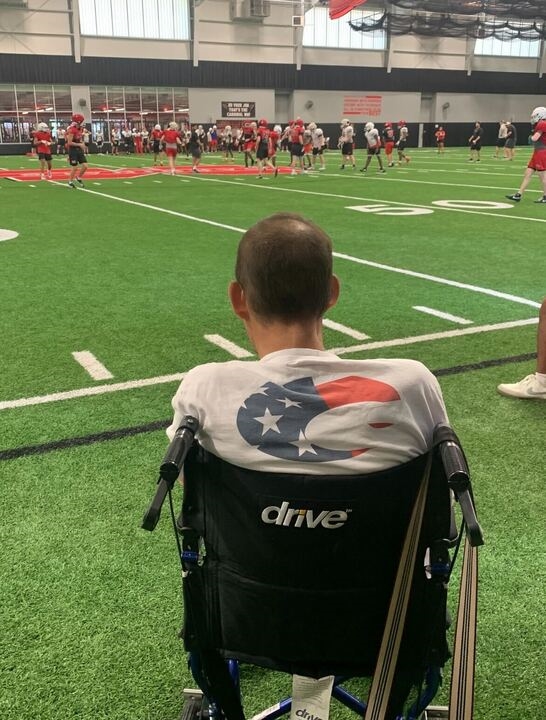
In between practice breaks, all of the players approached James for a high five. It was like an unspoken promise from the team that they’d look after his boy, vanquishing his final fear.
“I’ve never felt so supported by a community, and that’s not even just the Melissa football team,” Max said. “There are people that I don’t really know, and they’re texting me saying how sorry they are and to let them know if we need anything.”
Admittedly, Danielle was hesitant to participate in this story. She wants her son to be recognized for his own athletic achievement and the character he has, not just the recent tragedy. But while Max’s story has tragic elements, it is not a tragedy. This is not a story about death, rather the life a father and son shared, and the man it turned Max into.
“He is exactly what we all hope that our players are and become,” Melissa head coach Matt Nally said.
And this is why.
This article is available to our Digital Subscribers.
Click "Subscribe Now" to see a list of subscription offers.
Already a Subscriber? Sign In to access this content.
 Don't Miss Any Exclusive Coverage!