




COLLEGE STATION — With all due respect to the hundreds of athletes who competed on Day 1 of the Texas 7-on-7 STATE Tournament, the most impressive performance of the day came from a kid who didn’t play a down.
Now, you should know, if there was any way humanly possible that Kriztopher Alvarez could’ve suited up, he would’ve. But convincing his parents to even let him attend this event was a miracle in itself. Standing on the sidelines for two days, cheering on his Columbia teammates under the 100-degree sun, didn’t make sense to them. Not when Kriztopher has his final round of chemotherapy on June 30.
But in the seven months since doctors first found the golf-ball-sized tumor on Kriztopher’s brain that signaled Stage IV medulloblastoma, they’ve learned a couple of things about their son. One, he’s hard-headed. When he sets his mind on accomplishing something, like supporting his team at this tournament, there are no odds too long for Kriztopher to overcome. Except they used to think Kriztopher’s insatiable desire to beat cancer so that he could play his senior football season was linked to his ultimate quest for a college scholarship; almost like cancer was just some roadblock that he wouldn’t let stop him from achieving everything he ever wanted. And maybe it started as that.
But since that fateful day in December, they’ve realized that Kriztopher is only able to fight so hard because he’s doing so for a bigger reason than himself. It’s like he sees himself as the captain of this new team, a band of brothers across the nation battling cancer that he doesn’t even know, but hopes he can be an example for.
“I want to be a voice for everyone that’s out there who can’t be a voice for themselves,” he said. “I want to inspire all these kids to fight through it. Follow your dreams and don’t give up.”
Kriztopher’s dream, as mentioned, is the ever-elusive college scholarship. He was well on his way after winning district defensive MVP as a junior, a fearsome linebacker who racked up 121 tackles, 17 tackles for loss, and five sacks – all with a forearm cast from a broken arm he sustained in Week 3.
“He pretty much had a broken arm all year,” Columbia head coach Earnest Pena said. “He was a dude. Probably the toughest kid on the field every time he stepped on it.”
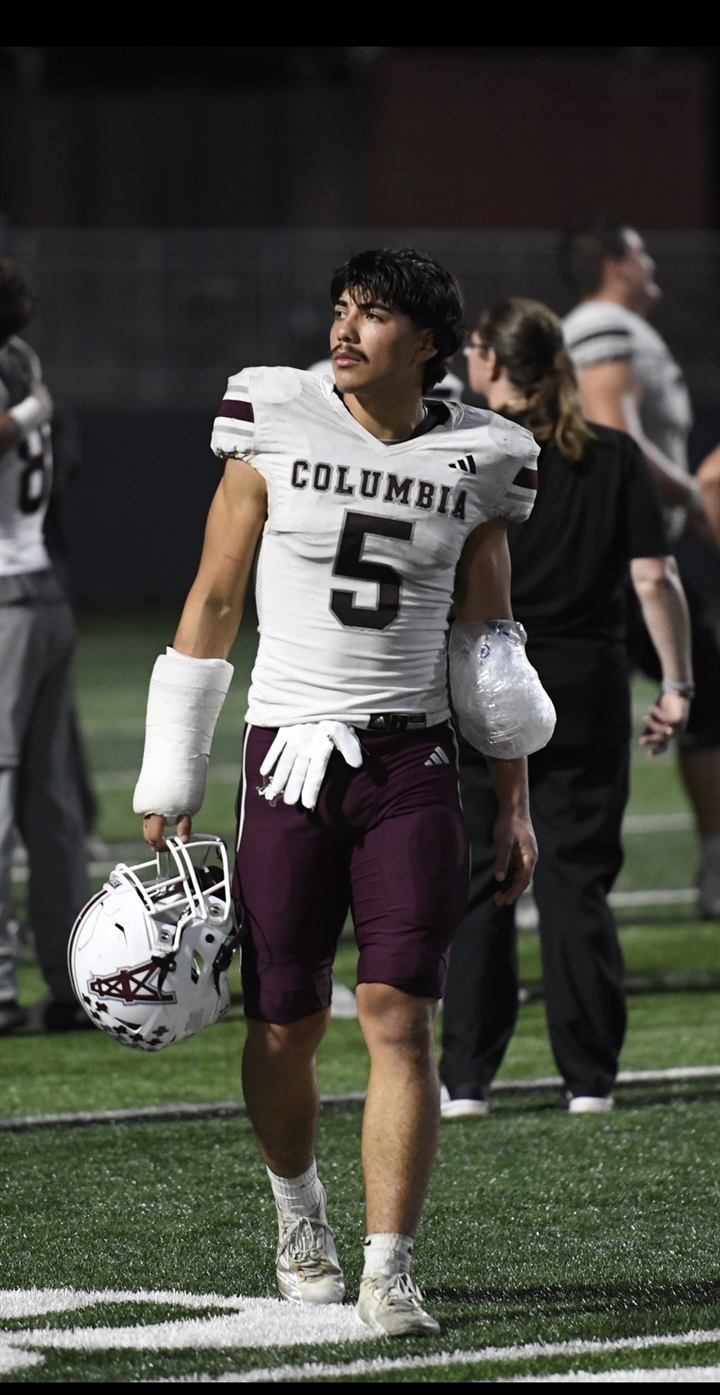
Today, sitting in a golf cart looking out on the field he so badly wants to play on before Columbia’s first game, Kriztopher still looks the part of an MVP. He’s only lost three pounds despite three rounds of chemotherapy. Frankly, the only difference in his appearance is a bald head under his baseball cap and the chemo port hidden under his shirt. When his appetite falters after treatment, and he wants to leave half his dinner on the plate, all it takes is his stepfather saying he can’t play football if he doesn’t eat. Kriztopher sits at the table until he can will himself to pick up the fork.
On the first day of Columbia’s strength and conditioning, when he was supposed to be easing back into a routine, Kriztopher instead ran until he puked. It all sounds like torture. But for Kriztopher, the torturous part is all the college camps he’s been invited to and can’t participate in. This cancer has caused all those opportunities he earned to slip away, leaving one senior season to earn it all back.
“I need an offer,” Alvarez says, with a smile that conveys how serious he is. “I need an offer, and I’m not going down without no offer. So I’m going to show out this year, do my best, and die trying.”
He says it with such conviction you’d think this was a goal he’d harbored since birth. Turns out, he has a confession to make. This kid is full of surprises.
“I used to always be scared of football,” he said. “I didn’t play all through fifth and sixth grade. But in my seventh grade year, all my friends were playing, and I felt so left out. By the end of that seventh grade year, I fell in love with football.”
He shares that passion with his stepfather, Robert Greco, a Columbia football alum. Ahead of Kriztopher’s junior year, when he first told Robert about his Division I dream, Robert decided to do everything in his power to make it happen. Robert stocked the garage with a weight set, while Kriztopher’s mom, Raquel Solis, prepped meals for him based on Texas A&M’s nutrition plan. Kriztopher worked out twice a day for an entire year. He and Robert would watch film of an opponent weeks in advance. Before the season opener against Needville, Robert pointed out how the quarterback always looked at one receiver whenever he booted out left. If Kriztopher saw the bootleg, he could jump the route. Sure enough, Kriztopher got a pick-six that night.
But Kriztopher’s breakout season was put in jeopardy in Week 3 against Bay City. As the Blackcats quarterback scrambled, Kriztopher lunged and brought him down by his shoelaces. But as the quarterback toppled to the turf, his knee slammed into Kriztopher’s arm. Kriztopher hobbled off, clutching his arm. Two plays later, he charged back onto the field. Robert, trying to save Kriztopher from himself, skipped down the bleachers until he was at the fenceline.
“I was trying to get the coach’s attention, calling to the sideline to pull him out,” Robert said. “But you just couldn’t with Kriz. He just refused to stop.”
Sure enough, as Robert hollered from the bleachers, Kriztopher blocked a field goal.
That Monday, the family went to see a specialist, who recommended a full-arm cast for Kriztopher. He was devastated. The doctor walked out to give the family a moment. Before the door even shut, Kriztopher was already chirping at Robert from the doctor’s table.
“Since December, you’ve been telling me, ‘Don’t settle. Don’t take this. Don’t accept that,”’ Kriztopher said. “And here we are, you’re gonna put a cast all the way up to my shoulder.”
Robert wanted to go by the doctor’s orders. But Kriztopher kept bargaining, pleading. Running out of arguments, he went for the Hail Mary. Why didn’t they flip a quarter, and he’d accept whatever the outcome was. Fine, Robert said. The doctor, who by this point had returned to the room, left again because she couldn’t bear to watch – and maybe because she was a little frustrated.
That’s how Kriztopher played the rest of the season in a half-cast.
“He was the heart and soul of our defense last year,” Coach Pena said. “How he works in the weight room and on the practice field – that’s how we describe ourselves as a team. We’re gonna compete, and we’re gonna fight until the last second. That’s who he is.”
But little did the coaching staff know what Kriztopher would have to go through to embody everything they want their kids to be.
The first signs that something wasn’t right came in the week of Columbia’s last game. Robert often works overnight for his job. One morning, he came home to Kriztopher throwing up in his bathroom. Kriztopher said he had a searing headache, but he chalked it up to dehydration, grabbing a Liquid IV before going to school. Despite Kriztopher’s brushing it off, his mom got on a waitlist for a neurologist, just to be safe.
Except the headaches got worse. Sometimes, the pounding in Kriztopher’s head was so intense that he would put his head on his desk and try to sleep in class just to shut off the pain. During a December offseason workout, Columbia had their players run a 5-10-5 drill. The workout is simple: run five yards left, touch the cone, run ten yards right, touch another cone, then sprint another five yards left. But as Kriztopher touched the first cone, his head exploded in pain. He wobbled, then lost balance multiple times within a span of 10 yards. When the coaches asked what was wrong, Kriztopher said he was seeing two of them.
The coaches had Kriztopher sit out the rest of practice. But when they returned to the coaching office, Coach Pena couldn’t get the image of one of his most athletic kids wobbling like Kriztopher was.
“This doesn’t sound right,” Coach Pena told the coaches. “This sounds pretty bad. Our kids have headaches every now and then, but they don’t stumble and move like he does.”
At about 2:00 p.m. that day, Robert got a call from Raquel. He needed to talk to Kriztopher because he wasn’t listening. Raquel wanted Kriztopher to go to the emergency room as soon as possible. But the football awards banquet was that night, and Kriztopher wanted to be there with his teammates. It’s like they were in the doctor’s office talking about the cast again – Kriztopher was bargaining. He’d go to the ER the second the banquet ended.
Robert still couldn’t grasp the severity of Kriztopher’s condition, but the gravity of the situation came into focus when he received pictures of Kriztopher accepting his awards at the banquet. Kriztopher is a jokester, the type of kid with a smile permanently plastered on his face. Sometimes, he’ll set an alarm for 5:00 a.m. on his eight-year-old sister’s tablet as a practical joke. But when Robert saw the pictures, he didn’t feel like he was looking at his stepson.
“He looks so dissatisfied,” Robert said. “He looks so upset or mad. It was not like him. The video I got of him, he was like a robot, almost.”
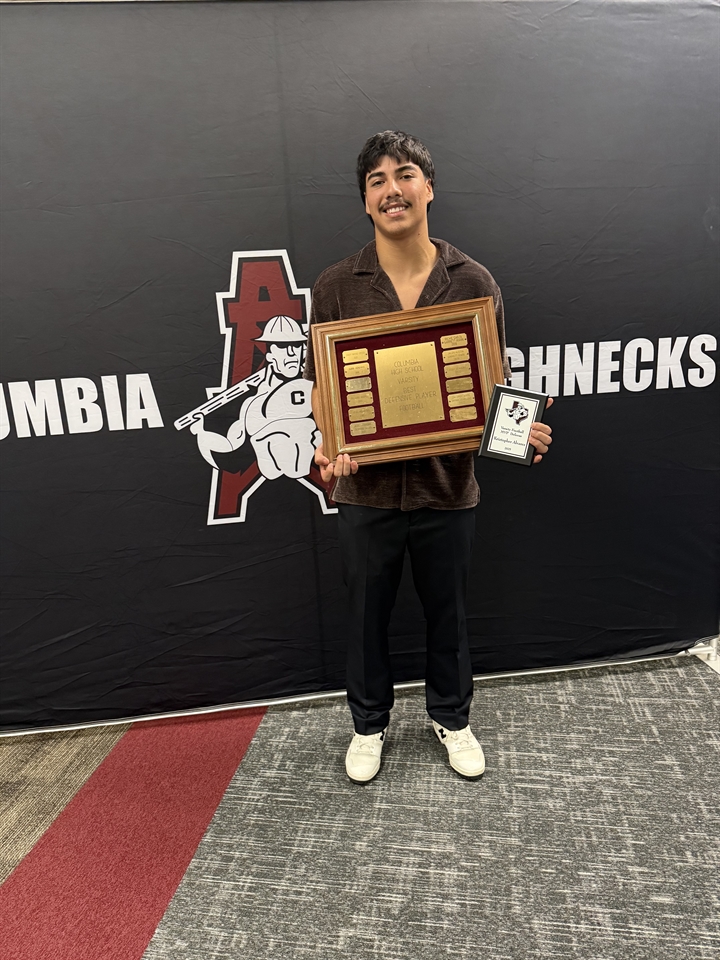
Raquel and Kriztopher put his plaque in the backseat and drove straight to an ER in Pearland. The CT scans were inconclusive. The doctor suggested this could be a condition from birth. But once the family pressed them, the ER referred them to Texas Children’s Hospital in Houston. Kriztopher’s MRI didn’t start until 4:30 a.m.
By 7:00 a.m., the family received the devastating news: Kriztopher had a golf ball-sized tumor in his brain. Stage IV Medulloblastoma. He needed open brain surgery that night.
Robert was experiencing every parent’s worst fear as he wheeled his stepson into surgery. As they walked down the hall, he racked his mind for the right words of encouragement. He needed to be strong for Kriztopher. But as Kriztopher got the IVs inserted, Robert realized his stepson was being strong for him. There were no tears. There were no cries of ‘Why me?’ There was just a kid on a mission.
“As they’re hooking him up, you’d think a normal 16-year-old would have all these questions,” Robert said. “As a stepfather, you want to keep him level-headed and say, ‘Everything is going to be ok.’ But, I’ll tell you, at 16 years old, he looked at me a couple of times and was like, ‘We’re going to be good.’ He was keeping me cool, calm, and collected, more than I was keeping him cool, calm, and collected.”
Really, Kriztopher was the most even-keeled of anyone in his orbit. Coach Pena got the call about Kriztopher’s brain surgery when he was at his son Ezzy’s Little League football practice. Before practice was even over, Pena pulled his son off the field. His son was bewildered. They never left the field early. But he stopped asking questions once he saw the tears – the fear – in his father’s eyes. Pena called the rest of the coaching staff, and they dropped everything to get to Houston.
“The love and support that we got from the coaches, with Coach Pena being the leader, and (defensive coordinator) Bubba Ryan, was unbelievable,” Robert said. “At this time, it was probably 11:00 p.m., and there were 4 to 5 coaches up there asking how everything was going and if we needed anything.”
The surgery was supposed to last seven to nine hours, but Kriztopher was done in five. The anesthesia knocked him out for another eight hours. When he woke up, Robert was by his bedside. Kriz motioned for Robert to come closer. His mouth was so dry he could only manage a whisper.
“Be honest with me, how bad is my hair?” Kriztopher asked.
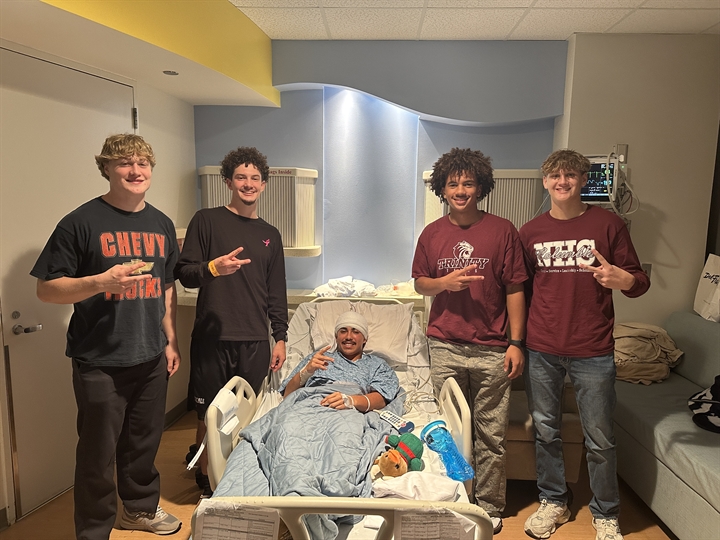
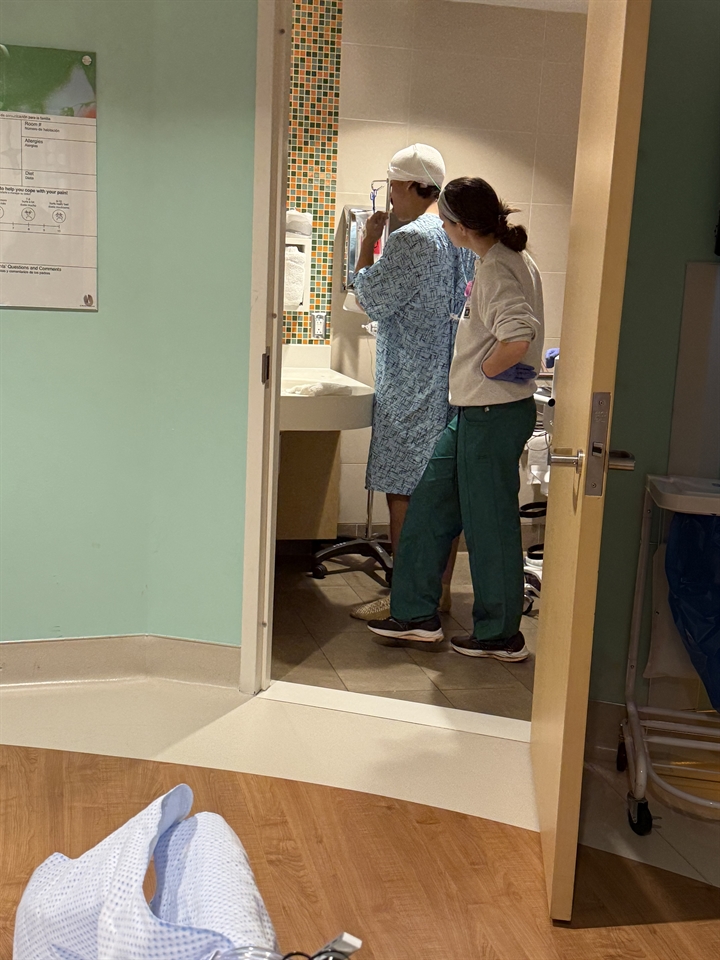
His hair was fine, Robert assured him. He tugged on it lightly, trying to prove it. But Kriztopher couldn’t feel it. Really, he couldn’t feel anything. The doctors said he wouldn’t be able to walk for a couple of days while he recovered. In the meantime, Kriztopher needed to brush his teeth. He’d had a breathing tube in for 13 hours, and his mouth tasted horrible. The doctors offered him a toothbrush and a bowl for the bed. In Kriztopher’s mind, it was another offer for a full arm cast. He wanted to brush his teeth at the sink like he always did. Again, he negotiated with Robert until four doctors and four nurses came into the room to help him up. It took a Herculean effort for him to walk to the sink, brush his teeth, then shuffle back to the bed and collapse back into it.
“He was so out of it,” Robert said. “He made himself nauseous. He was sick afterward. He couldn’t even move his head. As a stepfather, it frustrated me. I was like, ‘Why would you do that?’”
“I felt like I needed to accomplish something that day,” Kriztopher said. “I wasn’t going to just rot in bed and feel sorry for myself.”
It was a defiant act, one that set the tone for how the rest of Kriztopher’s cancer battle would progress. Five minutes before his surgery, he’d told his parents he’d play football in his senior year. He knew no doctor would believe it was possible. So he would have to beat all of their timelines. Don’t think I can walk for two days? I’ll do it right now. You think my football career is over? I’ll play in August.
Beating cancer requires will. But it is not a disease that can be willed away. Two weeks after Kriztopher’s surgery, he became extremely nauseous again. The family rushed him to the hospital. By the time they got there, his blood pressure had skyrocketed to the 220s. He was in and out of consciousness. As the doctors operated at his bedside, another group stood farther back, out of Kriztopher’s view but in an all-too-perfect view for Robert and Raquel, with the defibrillator at the ready. Kriztopher overcame it, like he does everything else. But this is the image seared in Raquel’s head whenever she thinks about Kriztopher playing football.
“It’s killing me inside,” Raquel said. “I am so terrified. But football, this is what’s got him through the whole journey.”
Two weeks ago, Kriztopher’s MRI showed zero cancer cells. It’s a remarkable recovery, and it’s fair to wonder if it would have happened that quickly had Kriztopher not had the ultimate carrot of a football season dangling in front of him. So while Kriztopher playing football scares his parents, they’re also doing everything in their power to keep the light at the end of his tunnel. Because it scared them when he played with a half-cast instead of a full one, and it scared them when he decided to brush his teeth the moment he woke up from anesthesia instead of waiting, and every time they’ve been proven wrong.
“The doctors probably hate me, because I’ve pressed them so hard on moving his therapies and chemo up,” Robert said. “I’ve questioned the restrictions they put on him for workouts. Because every time they restrict him, my mind flashes back to the times he’s looked at me and said, ‘Are you going to let them do that to me?’”
That attitude has spawned a movement in Columbia – Bet on number 5. Every fifth of the month, the community wears shirts in honor of Kriztopher. At the State 7-on-7 Tournament, Kriztopher looks around at the parents who are now wearing these shirts. For a long time, he’s felt like playing football was his ultimate purpose. Ironically, he feels like more people have been cheering for him on his quest to return to the field than they ever did when he was on it.
“I didn’t even know that this many people knew me,” Kriztopher said. “I was surrounded by so many people around the city and the state. It was such a blessing.”
Kriztopher believes he couldn’t have overcome this illness without football: both the goal of playing again and all the lessons he’s learned in the game. He says he uses his football mentality in every facet of his life. It turns out that all those nights lifting weights in the garage or studying film with Robert were preparing him for something far bigger than the football field.
“I always used to tell him, ‘If you’re going to do something, you better be the absolute best,’” Robert said.
Whether that’s playing football – or fighting cancer.
This article is available to our Digital Subscribers.
Click "Subscribe Now" to see a list of subscription offers.
Already a Subscriber? Sign In to access this content.
 Don't Miss Any Exclusive Coverage!