




Bill Elliott’s alarm blares at 3 a.m. Usually, he’s already awake.
Every Celina High School workday starts with a weight-lifting session. Elliott has set the clock earlier each season since he was hired as an offensive line coach fresh out of college in 1992. Success makes the target on his back larger, and last December’s 55-21 win over Kilgore was the eighth Celina state championship he’s coached for.
James ‘Choc’ Christopher, his back-door neighbor of 22 years, swears Elliott’s car headlights would flash through his bathroom window during his midnight pee. Jordan Roos, an NFL offensive lineman, remembers squatting and pressing a 400-pound barbell over his head before Coach Elliott did the same … with more weight.
Elliott towers over the Celina players, an orange polo spread tight over muscles that have grown muscles. He’s a devout Christian who’ll never cuss, but nobody mistakes him as mild-mannered on the field. His face, permanently tanned from the Texas sun, runs red in the heat of battle, with every vein bulging. He’s forever a TCU lineman who wishes he could line up in a three-point stance, too.
If Elliott looks like a Celina action figure, he cemented his hero status by winning the Class 4A Division I State Championship. Celina’s first title since 2007 marked the return of a Texas high school football dynasty. But the Bobcats aren’t just back, they’re reborn.
Farm kids from a tiny town in North Texas earned the program’s first eight trophies. The latest piece of hardware was the newest addition for a place whose population shot up 144% from 2019 to 2023. Celina has become what none of the townsfolk thought possible - Dallas’ next booming suburb.
So far, the community has found strength in numbers, adding people who learn to revolve around Celina High School into their football-crazed orbit.
The Celina offense, headlined by four-star quarterback Bowe Bentley, scored 51.5 points per game. Bentley earned Offensive MVP in the state championship after passing for five touchdowns and five incompletions, one of which was a dropped touchdown pass. Seven defensive players made First Team All-District.

“That’s the best Celina team I’ve ever seen play,” said Rex Glendenning, a member of Celina’s first state championship team in 1974. “On both sides of the ball, I think we had more talent this year than any previous year.”
But the town has outgrown the school that unifies them. High school classes are now held in the football team’s film room. There’s an active construction zone outside Celina’s fieldhouse as the school expands from a 1,500-person to a 3,000-person capacity. In May, Celina voters approved a $2.3 billion bond to open a second high school by 2030.
This may be the best football Celina has ever played. It's also the last few years that it’ll do so as one team. It’s as if the 2020s are Celina’s golden hour, the final minutes of the day when the setting sun provides the best light for pictures to cherish forever.
That’s why ending the mini-title drought has only made the town - and its players - hungrier for the next. They’re trying to take as many state championship photos as possible before night falls. The Bobcats return Bentley and Defensive MVP Luke Biagini. Dave Campbell’s Texas Football ranked them preseason No. 1 in Class 4A.
But Elliott can’t hear any of that outside noise at 3 a.m. He reads his Bible inside the palace the community built for his team. There’s a 70-yard indoor facility, two lecture-style film rooms, and, of course, that Division I-caliber weight room. It’s a living testament to football’s importance in Celina, and Elliott is one of three men who have held the keys since 1988.
The legendary G.A. Moore, who ranks third in TXHSFB history with 426 career wins, has a street named after him a mile down the road. He passed off his reign to defensive coordinator Butch Ford in the middle of a record 68-game winning streak in 2002. Ford went 122-16 with two titles before retiring in 2011.
Elliott is Celina’s past and present; he played for Moore and Ford in high school and has only ever coached for them. Every morning, he prays for guidance on leading it into the future.
When the sun rises today, the construction noises of Celina High School’s expansion will start again. The hum of the generators and cement mixers constantly reminds Elliott he must work harder to keep this program in Moore and Ford’s image. They built this dynasty in a town with one flashing light and a two-way road lined with tractors. The school district projects four high schools in the next two decades.
“At some point, not everybody is going to be a Bobcat that lives in town,” Christopher said. “Not everybody is going to be in orange and white.”
Why does that matter? Why is Elliott proposing to the school board that every new high school have the Bobcat mascot and orange and white jerseys? Because those are rites of passage in this town - how boys grow into men.
Over a seven-year NFL career, Jordan Roos grew a beard to his chest and hair to his back. Celina has a haircut and no earring policy - all players are clean-shaven and wear their hair over the ears. For Elliott, it’s a test. The program doesn’t mean much to a kid if he won’t give up an earring or get a haircut to be in it.
When Roos spoke to the team ahead of homecoming, he told them he’d shave his head tomorrow if he could come back and play for Celina.
“I wanted to get back and tell them how special it is,” Roos said. “It’s not like this everywhere. This isn’t the norm. Celina is unique and uncommon.”
Celina’s program unofficially starts in second grade. Elliott and the varsity coaches host a yearly clinic for the Little League coaches. They run the high school’s base offense and defense. All teams wear orange and white. Every boy in this town doesn’t just dream of being a Bobcat; they grow up as one.
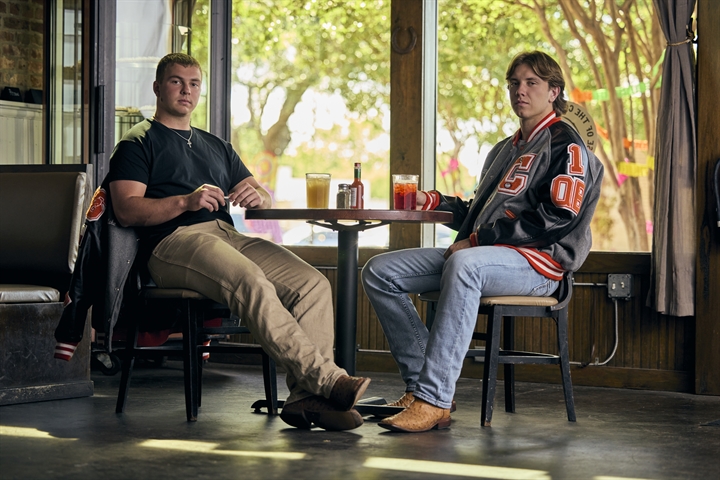
“(My favorite memories are) At the old Bobcat field, standing on the fence watching everyone warm up, and Coach Elliott coming and giving you a high five,” quarterback Bowe Bentley said. “It was just the coolest thing ever.”
It’s like every boy goes through voluntary football indoctrination. Once they reach high school, they will not let the standard of the program they’ve always loved drop. Willpower, not scheme, was always Celina’s secret sauce.
GA Moore created the famed 10-1 defense, with ten players along the line of scrimmage and a roaming middle linebacker seemingly making every tackle. Celina controlled the game with a smash-mouth rushing attack that was entirely one-dimensional.
Whether playing in a college stadium or nursing home, the Bobcats would outwork the opponent. The other team quit before the final buzzer sounded. The truth is Celina rarely had elite athletes. But every athlete had elite buy-in.
“Whenever you saw a Celina team running on the field, it looked like the other team was going to kick Celina’s ass,” Rex Glendenning said. “We never really did have the biggest kids or fastest kids. But they were disciplined and motivated kids who bought into the program and fought their hearts out.”
Celina won four straight state championships in the late 90s and early 2000s. By then, the entire town was all in.
Moore had started a mentorship program within the booster group, the Celina Quarterback Club, where an adult male would be assigned a high school athlete to support with pregame snacks, gameday signs, or just a shoulder to lean on. In 2002, there were 80 men signed up to be mentors.
“Most of my buddies that go to games with me, our kids have been gone for 10-plus years out of high school,” James ‘Choc’ Christopher said. “A lot of us never had kids that even played football.”
In August 2010, country music star Kenny Chesney’s “Boys of Fall” video debuted on SportsCenter. Chesney and crew had traveled to America’s most renowned high school football towns, an ode to Friday nights.
When Chesney sings, “In little towns like mine, it’s all they got. Newspaper clippings fill the coffee shops,” the quaint shop shown has “We Believe” in Celina orange spray-painted on the window, with Bobcat jerseys strung next to it. Inside, the framed newspaper reads, “Title push begins anew for the Bobcats.”
Those lyrics perfectly depicted what Celina was for a long time. The spirit is still there - the downtown today has a 2024 state championship flag proudly displayed. It’s just in front of a construction site for a new four-story parking garage, the first phase of the Downtown Center project.
The murmurs of a population boom began in 2011 when then-Mayor Corbett Howard informed the Celina ISD School Board of his growth projections.
“I didn’t believe him to save my life,” school board president Jeff Gravley said. “I thought, ‘Yeah, we’ll have an influx of people.’ But not to the extent of what he was saying. Well, he was probably 50% low.”
The Dallas North Tollway and Preston Road are two major thoroughfares that run parallel. The area between them is called the ‘Golden Corridor.’ As construction brings those roads - and easy access to the city - north, boomtowns are created. There was Plano in the 1990s and Frisco in the 2000s. Now, it’s Celina.
The roads explain the rapid growth from 2010 to 2020 when Celina went from 6,028 residents to 16,739. But the COVID-19 pandemic and the cultural headwinds it brought sent Celina into hyperdrive.
Strict lockdown orders in New York and California were the last nudge for people on the fence about moving to Texas. Rising inflation made the state’s lack of state income tax and low cost of living attractive. The Dallas-Fort Worth airport made North Texas a convenient destination. Celina’s school system made it a great spot to raise a family.
Now, Celina has 60,323 people. Everybody bought into the small-town dream and made it the fastest-growing city in America.
“No matter how much we prepare, it seems like we aren’t doing enough,” Gravley said.
Celina’s football team, like the town, has modernized. In the 2000s, the team had two pass protection schemes - “Booty Left” and “Booty Right” - which told the linemen how to turn while the quarterback rolled out. In 2024, Bowe Bentley threw for 3,211 yards and 47 touchdowns.
But the offensive evolution dates back to when Bill Elliott took over as head coach in 2012. His son, Nathan, was a rising sophomore who could spin it and had a good crop of wide receivers. Nathan’s class flipped Celina’s script. He finished his career with 8,821 yards and 110 touchdowns before playing at North Carolina.
Nathan, now Celina’s offensive coordinator, is the last alum to play Power Four football. His protégé, Bentley, will soon snap the streak. Bentley went from zero scholarship offers to 30 in one season as the starting quarterback. Georgia, LSU and Oklahoma are his finalists.
“In my 32 years, we’ve never had a kid like him in this program,” Bill Elliott said. “The arm talent, the ability to run, the vision, he is unbelievably talented.”
Bentley represents the new Celina, but his work ethic is old-school Bobcat. He lives in the film room, a sponge for Nathan’s knowledge from North Carolina.
“I knew I had to be different,” Bentley said. “Getting my teammates up here to work on Saturdays and Sundays, no matter what day it was, 4:30 in the morning or 9 at night. We all had one dream: to win a state championship. We were going to do whatever it takes to accomplish it.”
While Celina embraced the future with Bentley, they honored the past with two 1,000-yard running backs, Logan Gutierrez and Harrison Williams. The Bobcats still line up in the “T” formation - albeit not enough for some.
“I still wonder sometimes why they don’t run the ball more,” former head coach Butch Ford said.
But fans like Rex Glendenning appreciate that the program holds the same values as when he played. The Glendenning family has lived in Celina since 1887. Rex was on the first state championship team in 1974 and is still intimately involved with the program. Glendenning lines Preston Road with spray-painted hay bales before playoff games, as seen in the “Boys of Fall” video. He coached the Celina 7-on-7 team to four state titles.
Glendenning loves this town and program. But he’s also the land broker who will profit from its change.
“Sometimes people ask me, ‘Do you feel bad about all the growth around you?’” Glendenning said. “I kind of have to say, ‘I’ve been envisioning this for three or four decades.’”
It’s impossible to throw a football in Celina without hitting a “REX Real Estate” sign advertising a plot of land for sale. Every year since 1991, Glendenning bought a farm in Celina he deemed suitable for later development. From 2001-04, he served on the Dallas North Tollway extension committee that procured the rights from US 380 to Gunter. He waited for the people to come and the businesses that needed his land to follow.
By March 2023, D CEO Magazine featured him on its cover, entitled “The Land Man.”

“Celina will be the biggest city in Collin County because we have a bigger footprint,” Glendenning said. “We have 40% more dirt than Prosper and about 20% more dirt than Frisco.”
The last of Plano High School’s seven state championships was in 1994. Of the city’s three high schools, Plano East is the only one with a winning season in the last six years. Frisco has 12 high schools and one state championship appearance (Lone Star) between them.
But what worries Elliott most in these early mornings by himself in the office - the community lost when more schools are added. The hard truth is that the more people hop in the boat, the harder it is to row in the same direction.
That’s why Celina has a few team rules that will not change with time. Most involve an individual sacrifice for the team. Haircuts and no earrings are one. All players and coaches wear long white socks during the season. There is no offseason uniform, but orange, white and gray are required. Black clothing is forbidden, a tradition from an old rivalry with Pilot Point.
At this point, the rules are player-enforced. This spring, a freshman with a broken arm was sitting out offseason workouts when Ty Hughes, a departing senior center from the state championship team, approached Coach Elliott.
“Coach, what’s that kid doing out there?” Hughes asked.
“Oh, he’s a freshman,” Elliott said. “He’s hurt right now.”
“He’s got black on!” Hughes said.
With that, Hughes, technically graduated from Celina football and off to West Texas A&M, walked out to the field and pulled the kid aside. He hasn’t worn black since.
In these moments, Elliott wants to run through a brick wall - and into the future.
There’s a framed note on Elliott’s desk. He wrote it to his father when he was 9 years old, begging Dad to let him quit football. It was too hot. He was too chubby. His dad walked into his bedroom that night and told him that if he quit now, he’d quit the rest of his life.
Elliott tears up when he talks about this letter. His father’s refusal is the reason he ever started coaching at Celina. It’s also what’s keeping him here.
This article is available to our Digital Subscribers.
Click "Subscribe Now" to see a list of subscription offers.
Already a Subscriber? Sign In to access this content.
 Don't Miss Any Exclusive Coverage!