




THORNTON, Texas – Like most young men in Texas, James “JD” Linnstaedter’s love of football was inherited from his family just as much as his name.
Some of JD’s earliest memories are throwing the football in the front yard of his grandfather’s lake house in Thornton, Texas. The boy admired his “Pa” for many reasons. James “Jimmy” Linnstaedter, now closing in on his 85th birthday, is the type of man they just don’t make anymore: a decades-long football coach who built a houseboat on Lake Limestone and helped construct his own two-story home. But while those details were cool, the thing JD has always most revered about Pa was his athletic career.
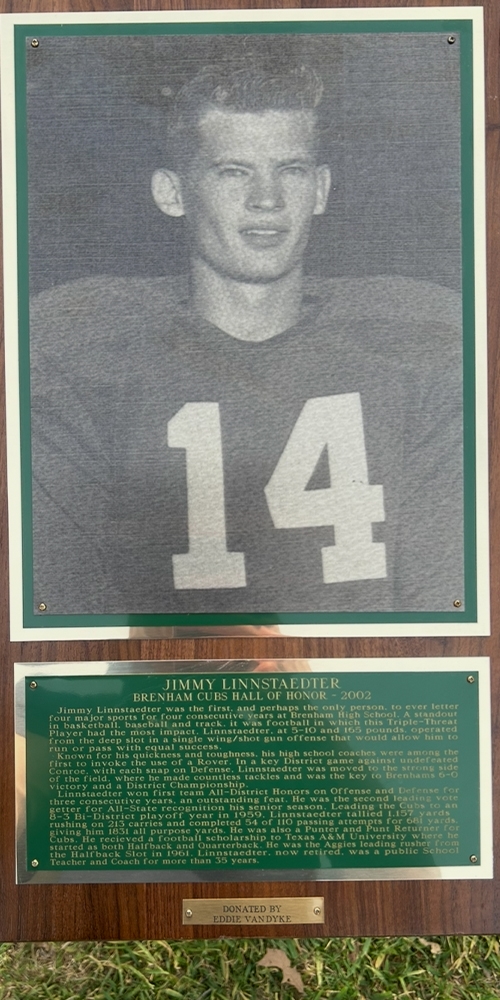
Jimmy was the first, and still the only, Brenham High School student to earn four varsity letters in the four major sports for four consecutive years in the 1950s. Then, he blossomed into Texas A&M’s leading rusher from the halfback slot in 1961. Not that JD knew all this as a child in the front yard. He didn’t discover these facts until his freshman year of high school, when his Montgomery Lake Creek Lions traveled to Brenham, and he stumbled upon Pa’s Hall of Honor plaque. Jimmy never talked about himself. His achievements would only surface in hints and allusions to the good old days. If you weren’t paying attention, you’d miss it. Jimmy wasn’t the type of guy to boast, much less twice.
So JD would cling to these stories about Pa for dear life, not knowing when he’d hear the next one. He’d ingrain them into his memory until they became as much a part of his own story as his Pa’s. Now an incoming freshman quarterback at Schreiner University, JD reached college football by competing against the high school version of his Pa this whole time.
If JD’s football career has been a lifelong race against Jimmy Linnstaedter from 70 years ago, then the starting block was that front yard in Thornton. Those were the first glimpses of the young boy’s rocket arm, and Pa was his first receiver. That is, until one day when Pa decided to play defense.
“Intercepted!” Jimmy said, as grandfather and grandson both busted out laughing.
Then, he tossed the ball back to JD – and also threw in a fun fact that would rock the boy’s world.
“You know, I had 35 of those one year in high school.”
Wait – what?
Even to JD’s 10-year-old brain, 35 interceptions in a single season seemed impossible. The NFL and FBS records for single-season interceptions are 14. Did teams even throw the ball 35 times in a season in the 1950s when Pa played?
That night, JD got on the computer and typed “Jim Linnstaedter 35 interceptions” into the search bar. Sure enough, the record popped up on Dave Campbell’s website. Jim Linnstaedter was listed as the state’s all-time leader with 35 interceptions in the 1956 season. Like all good researchers, JD had to verify it. That could’ve been a typo. But then he went to the NFHS national record book and saw that, not only was Pa the state’s all-time leader for single-season interceptions – he was the country’s all-time leader.
JD sprinted into his dad’s room with the evidence. Dad, he said, did you know Pa has the national record with 35 interceptions in a single season?
James Linnstaedter was just as shocked as his son. His dad had been his coach his entire life. James knew about Jimmy’s all-state career at Brenham and Texas A&M days. But he’d never heard about an interception record.
“The interesting thing about Dad is that he doesn’t really brag,” James said. “So I don’t think any of his football players really knew he had all those records.”
So JD planned to let everyone know on his grandfather’s behalf. He might as well have been floating on a cloud walking into the school cafeteria the next day. His grandfather was a legend, and he had the goods to back it up.
“At first (my friends) were like, ‘No way,’” JD said. “But then I got on my phone and showed it to them. You can’t argue with Dave Campbell’s.”
Except, what if you could? And what if people had?
As a sport, Texas high school football is particularly susceptible to inflated or outright false stats. After a century of play and over 1,500 teams, there are simply too many players for a perfectly centralized bank like the NCAA or the NFL has.
Really, the closest thing Texas high school football has is one man – Joe Lee Smith. Inducted into the Texas High School Football Hall of Fame in 2007, Smith has spent six hours a day since 1965 compiling season-by-season football scores and stats for his website Texas High School Football History. His database is beyond impressive, with troves of individual stats dating back to the 1920s and season-by-season records for every public school 11-man program. Smith has dedicated his life to an incredible act of service, a one-of-one character we can all point to as part of what makes Texas high school football different from any other sport in the world. And yet, even his website is incomplete. It does not hold any six-man or private school records. There aren’t any tackling records either. Adding those would be impossible.
So Texas high school football fans have Smith, Dave Campbell’s record book, and the NFHS record book as an imperfect amalgamation of the sport’s all-time leaders. There is no way to have a records official at all of the thousands of Friday night football games. Really, they’re beholden to the high school football coach, and, maybe, the local beat writer. And in an age where newspapers are gutting high school coverage, it’s even more difficult to establish records. For instance, we know that Mount Enterprise’s Kaegan Ash broke Kenneth Hall’s single-season rushing record this past year. But do we really know that? Did we watch every run and chart it? Or did we watch the highlights and take the Mount Enterprise staff at their word? (I’m not trying to disprove Ash’s record – it happened. Just trying to prove a point.)
For these reasons, Kevin Askeland, a longtime senior writer and high school football historian at MaxPreps, has always been skeptical of “unbreakable records.” It’s not that he has a personal vendetta against any of the record-holders. In his mind, if he finds out a record is wrong, he’s giving the next generation a fair chance to break it. And the more records that get debunked – like Netcong High’s John Giannantonio’s 4,756 yards in the 1950 season and 754 rushing yards in a single game, or Bedford County Training’s 52 straight shutouts in the 1940s – the more motivated he is to sniff the rest out.
Askeland has had his eyes on Jim Linnstaedter’s single-season interception record for at least half a decade. In that time, he believes he’s found plenty of damning evidence. For starters, the record occurred in 1956. Linnstaedter was a freshman that year. And, Brenham had its worst season in three decades, posting a 1-8-1 record. That means Linnstaedter had to have 3.5 interceptions a game for a team that only won one game.
What’s more, Askeland has actually dug through the Brenham Banner-Press archives. The paper has a box score of statistics for every game. As a team, the Cubs had only seven interceptions all season.
Askeland thought that maybe Linnstaedter had 35 interceptions his entire career, not in a single season. So he moved on to Linnstaedter’s sophomore year in 1957. That season, Linnstaedter is listed with eight interceptions, including three in one game. But the entire team had just 15. The Brenham Banner-Press had more of the same story in 1958 (Linnstaedter is listed with four interceptions) and 1959 (three). All told, that’s 15 interceptions over four years, not 35 in his freshman season alone.
So where the hell did the 35 interception total come from? That’s the question I set out to answer when I visited the Linnstaedter family on Lake Limestone. Only, the story I expected to be focused on a record turned into the tale of a family fighting for its legacy.
“Everybody likes the underdog,” James said. “I think my dad is an underdog in this because there are so many people trying to refute the story. It was documented and documented again. But (the number is) so unbelievable that people want to take it away.”
…
I felt like I was shaking hands with a celebrity the first time I met Jimmy Linnstaedter. His 85th birthday is approaching in September. But he still bears a striking resemblance to the young man I’ve seen plastered all over the Brenham Banner-Press sports pages in the 1950s. Time hasn’t taken away the full head of hair or that lean, wiry build that glides up and down the stairs to his second-story porch.
“Is it true?” I nervously blurted out before I’d even stopped shaking his hand.
“Yes,” he says.
Let’s step inside the living room, and he’ll tell you how that impossible record happened.
Originally, Linnstaedter thought his future was in baseball. Growing up on the poor side of Brenham, he and all the neighborhood boys played soda water cap baseball every day until the sun set. This was long before the days of select youth sports and travel teams with customized bags. Instead, the pitcher would flick the cap of a Coca-Cola bottle between his thumb and middle finger, sailing and curving it toward the plate. The batter was allowed to hit with a wooden board until they were eight years old. Then, they graduated to a broomstick. For years, Linnstaedter honed his hand-eye coordination by smacking the cap with his broomstick. If you think hitting a baseball on the sweet spot is tough, imagine how difficult it is with these tools.
By the time he was 14, Linnstaedter was recruited to play in a semiprofessional baseball league. The promoter told him that if he pitched for him on Sunday afternoons, he could get free tickets to the town hall dance and two free beers. Linnstaedter took the tickets, and his father took the beers.
But in those days, every kid played every sport, so Linnstaedter went out for Brenham’s football team as a freshman. The Cubs were a powerhouse 2A program. But in 1955, the year before Linnstaedter started high school, the state of Texas passed a law that closed all the little country schools surrounding Brenham. All those kids came to Brenham High School, and elevated the team to 3A. Brenham had enough kids in the school for football, but none of them actually played. Instead, the Cubs faced off against established powers such as Bryan, Huntsville, Conroe, Wharton, and El Campo with just 18 varsity players.
“I remember when Bryan came to us my first year in high school, they had more students in the band, choir, pep squad, and football team than we had in the whole high school,” Linnstaedter said.
Because his team was so outnumbered, Brenham head coach Tommy Mims decided his Cubs needed a different scheme to compete. Nobody threw the ball in the 1950s. Every team ran some variation of Vince Lombardi’s offense with the Green Bay Packers. The quarterback would pitch the ball to the halfback, and every lineman blocked the man lined up directly inside of them.
“The football was short and fat,” Linnstaedter said. “It was shaped like a volleyball. It was hard to throw. The passing ball didn’t come in until 1963 or 64.”
Since no team was a passing threat, every defense ran either a 6-3-2 or a 5-4-2 scheme. But Coach Mims knew his Cubs would get mauled if they ran this. Instead, he implemented a 10-1 defense – 10 down-linemen, and one man roaming in the secondary as the last line of defense. That man was freshman Jimmy Linnstaedter. With so many linemen screaming into the backfield as soon as the ball was snapped, the other teams had no choice but to throw. Except they didn’t practice passing, and they often threw blindly under the pressure.
“There I was sitting back there in centerfield,” Linnstaedter said. “They would throw 30 passes a game, and I probably should’ve had eight or nine interceptions a game. I just couldn’t jump or get to the ball quick enough. They were forced to throw the ball and weren’t prepared to throw the ball.”
Part of the reason Linnstaedter never beat his chest about having 35 interceptions in a season was that he never really thought it was his award. That feat was a credit to the scheme. He was just the lucky one who got to play free safety.
“That interception record came from a coaching standpoint of having a nine-man, 10-man front and making that other team throw the ball,” he said. “It was all the difference in the world to make me seem great. I don’t know if I was much better than anybody else out there; it was just the way it was set up.”
Frankly, he’s not surprised the interception record was never mentioned in the Brenham Banner-Press during his playing days. Back then, defensive stats weren’t given the same weight as the offensive ones. The NFL didn’t even start tracking sacks as an official statistic until 1982. And, the way he remembers it, the record people focused on at the time was his rushing yards.
Linnstaedter was only supposed to play defense as a freshman. That all changed in Week 1.
“Our star, 6-foot-4-inch running back broke his leg about the first quarter of the first game of the year,” Linnstaedter said. “We were gonna win state with him, just hand the ball off to him, and he’d run over everybody.”
The entire stadium was in stunned silence as Brenham’s big back laid there with his leg going the wrong way. The doctors didn’t even know how to properly load him onto the ambulance without hurting him more. As they stood there scratching their heads, Coach Mims called Linnstaedter over.
“You’re now the running back,” Mims said.
“Oh, Lord,” Linnstaedter replied.
He didn’t know but three of the plays. So the coaches lined him up in shotgun – one of the first teams to use the formation – and simply called “Linnstaedter Right” and “Linnstaedter Left.” As you could imagine, a scrawny freshman running left and right wasn’t exactly a high-powered offense, even by 1950s standards. So, even though he was intercepting over three passes a game, it’s not like Brenham took advantage of those takeaways.
Brenham skidded to a 1-8-1 record that year. But that season laid the foundation for the next three years, when a battle-tested Brenham bunch went 24-8 with two district titles. Linnstaedter became the team’s star player. He won First Team All-District on both sides of the ball as a sophomore, junior, and senior, taking All-State honors his final two years. As a senior, Linnstaedter rushed for 1,157 yards and threw for 681 more, earning a scholarship to Texas A&M.
“I’d never trade Jim Linnstaedter for any other football player,” Mims said in a Brenham Banner-Press article on October 16, 1959. “I may have let him down on occasions, but he has never let me down in the four years I’ve coached him.”
Brenham is only about 40 miles south of College Station, but it might as well have been a different world to a country boy like Linnstaedter. As he sat in his freshman year college English class, he scanned the room and could’ve sworn there were more people in this one class than in his whole high school. Perhaps that’s why he remembers what happened on the first day so vividly.
The professor had everyone in the class stand up and introduce themselves with their full name. But his finger bypassed Linnstaedter. When he’d called on the last kid and everyone sat down, Linnstaedter did, too. Big mistake.
“Linnstaedter!” the professor yelled. “Did I call your name out?”
The professor bounded across the room, standing over Linnstaedter’s desk in an instant.
“You don’t remember me, do you?” the professor said.
“No, sir,” Linnstaedter responded.
“Do you remember the Cleburne football game?” the professor asked.
“Yes, sir,” Linnstaedter said, now thoroughly confused.
“Y’all got beat, didn’t you?” the professor said.
“Well, yes, sir, we sure did,” Linnstaedter said. “The referee made a really bad interference call.”
“That was me,” the professor boomed. “You tried to run me down and embarrass me in front of 4,000 people at a football game. Now you’re in my class, and you have no chance to pass this class.”
That professor’s name was Dr. C.K. Esten. There’s now a scholarship in his name at the school. Sure, he taught English. He also founded the Aggie Players drama group. Oh, and he just happened to be the Voice of Kyle Field, the first public address announcer for Texas A&M football games. Not only did he provide the soundtrack for Linnstaedter’s touchdowns over the next three seasons, but Linnstaedter took his class every year, becoming one of his favorite students.
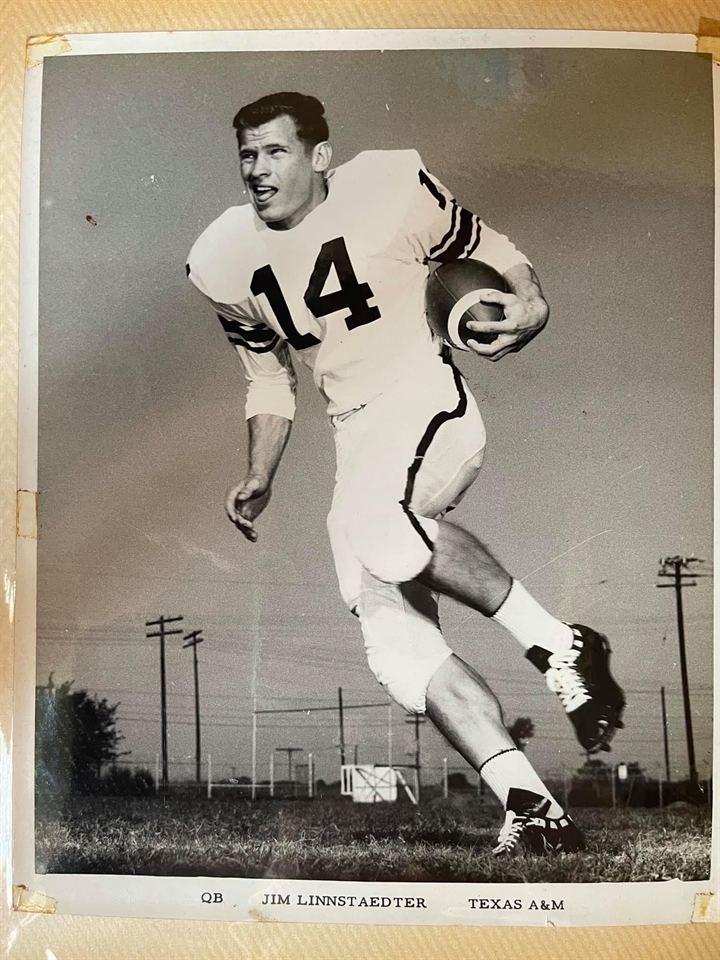
But Professor Referee was not the only thing that followed Linnstaedter from Brenham to College Station. Somewhere in his four years donning the Maroon and White, the legend of his 35 interceptions in a single season spread around the football team.
“The interception record didn’t come out until I was at Texas A&M,” Linnstaedter said. “The 35 number didn’t register anywhere in high school.”
It turns out that Linnstaedter wasn’t the only man to make the trip from Brenham High School to Texas A&M University.
At the beginning of Linnstaedter’s sophomore year, Texas A&M’s Sports and Information Director left for the University of Texas. Sports and Information Directors are vital to college athletic departments. Not only do they compile game recaps and stats, but they also coordinate all independent media opportunities for the team, in addition to about 1,000 other duties.
When Linnstaedter was in high school, a man named Tommy Blake was the sports editor at the Brenham Banner-Press. Naturally, the two became close over four years. Linnstaedter was the star athlete, and Blake wrote about the team every week for the paper.
Shortly after Texas A&M’s SID left for the Longhorns, Linnstaedter was walking to a meeting in the Texas A&M coaches’ office. He almost breezed right past Blake before doing a double-take. He didn’t expect to ever see him again.
“Wowwww,” Linnstaedter said. “What are you doing here?”
“I’m the new sportswriter at Texas A&M,” Blake said.
Linnstaedter had a gut feeling then, which has hardened into a belief over all these years, that Blake’s appearance at Texas A&M wasn’t a coincidence.
“I’m almost 90 percent sure that Jim Myers, the head coach at A&M, told him, ‘If you get Linnstaedter to come to A&M, you can be the next sportswriter at Texas A&M,’” Linnstaedter said.
So, this was how Linnstaedter’s high school interception record leaked out. He never talked about it during his freshman year for all the reasons we’ve covered – humility and the belief that it was a coaching accomplishment. But now there was someone in the building who lived through Linnstaedter’s high school years. Chronicled them. Wrote stories about him. Made him into a legend.
But if Blake was the one who brought Linnstaedter’s achievement into the mainstream, why did he never write about it in real time for the Brenham Banner-Press? Blake passed away in 2013. And, with him not here to answer anymore, I bounce the theories around in my own head. They range from the most cynical to innocent. Part of me wonders what if Blake created the record to get Linnstaedter into A&M so he could get the SID job? But that’s a grievous and unfair accusation on a journalist, especially one of Blake’s caliber.
Blake was the Texas A&M SID until 1963 before embarking on a long and storied career at the Fort Smith Times Record in Arkansas. He wasn’t a sports reporter anymore, but he still listened to ball games on the radio when he would drive his four kids from Arkansas back to Brenham for the holidays. In his obituary, Jay Harshaw, a features clerk at the Fort Smith Times Record who answered Blake’s phone all day, summed Blake’s professional life up with the highest honor for a journalist.
“One thing I did learn from him was never ignore the phone,” Harshaw said. “He would get anonymous calls all the time, and he would always check them out — and no one ever questioned what he wrote.”
Besides, there’s proof that Blake didn’t pull that stat from thin air.
We’ve established that Askeland over at MaxPreps has counted only 15 career interceptions in Linnstaedter’s career after digging through every game log from 1956-59. He acknowledges Linnstaedter could’ve had a couple more that weren’t credited to him. But not as many more as would be required for what he found next to be true.
“Which makes an article in the Fort Worth Telegram on November 30, 1959, rather curious,” Askeland wrote in an email. “In it, Brenham coach Tommy Mims said JL (Linnstaedter) had 39 interceptions in his career.”
Askeland believes his research into the game logs over this singular quote. His leading theory on where that 39 came from? A typo.
“This would make sense because an article in the Houston newspaper in the late 1970s when Linnstaedter was a coach at Nimitz said JL (Linnstaedter) had 19 interceptions,” Askeland said. “But it made it sound like he had 19 in a season, which he clearly never did.”
Let’s take the other side of the argument into account, too. What if Mims was not misquoted, and he really believed Linnstaedter had 39 interceptions in his career? He would’ve gotten that stat from Blake, who interviewed Mims and his players on an almost daily basis. Frankly, Mims’ coverage of the team is impressively extensive – and a relic of the past, when a beat writer covered one high school team like it was an NFL franchise.
In that case, Blake would’ve never intentionally made up the 35 interceptions in a single season stat. As time passed, his memory might’ve turned it from a career accomplishment into a single-season accomplishment in a case of innocent rosy retrospection. As a journalist who talks to people about the past for a living, I know how common that is. Over the past months, I’ve been compiling lists of the 10 greatest Texas high school football players at each position (shameless plug, but bear with me). As I poll coaches, coworkers, and other media members, I find that the person they deem the best of all time is often someone they played against as a kid, coached against in their first couple of seasons, or covered early in their career. Blake was a young journalist when he covered Jimmy Linnstaedter. How often do we exaggerate the feats we witnessed in our formative years?
For over two decades, Linnstaedter’s interception record remained an unverified legend. Blake moved to Arkansas. Linnstaedter embarked on a three-decades-long career as a public school football teacher and coach. Everyone kind of moved on. That is, until the Houston Chronicle’s Bill McMurray brought the record back to the forefront of our minds. McMurray, inducted into the TXHSFB Hall of Fame in 1988, published a history book titled “Texas High School Football” in 1984 that is widely considered the best ever written on the sport. On page 468, Brenham’s Jim Linnstaedter is listed as having 55 career interceptions from 1956 to 1958 (Linnstaedter actually played through the 1959 season). Right below it, he’s listed as the all-time record holder with 35 interceptions in the 1966 season. Because Linnstaedter played from 1956-59 (and it’s denoted as such in his career record), the 1966 figure was widely panned as a typo referring to the 1956 season – Linnstaedter’s freshman year.
That’s how Linnstaedter’s record, while unbelievable, has been taken as a cold, hard fact for over 40 years. Most people who’ve grown up around the game, like THSCA Assistant Executive Director and longtime Brenham coach Glen West, have approached the record exactly like Linnstaedter’s grandson, JD, did. It’s written in plain English in McMurray’s 1984 book, Dave Campbell’s Texas Football, the NFHS record book, and the Texas Sports Writers Association record book.
“It’s recorded, so I would have to think it’s factual,” West said. “I have no way to dispute it, and we certainly never tried to. And he certainly said it was factual when you talk to Jimmy himself.”
Except someone like Askeland did have the time, resources, and will to dispute it. And now, armed with the Brenham Banner-Press sports pages, he’s going to war against the four encyclopedias of Texas high school football where it’s listed.
The Linnstaedter family knows people like Askeland are out there, poking holes in Jimmy’s record. And they understand why. Everyone who sees that figure for the first time immediately assumes it’s a typo, or a career record mistakenly denoted as a single-season one. Jimmy’s son and grandson probably would’ve, too.
“If you rationally think about it, it’s very difficult to hit those numbers,” James said. “But I listened to my dad say, ‘Hey, look, we ran a 10-1, and we would blitz and make you throw. The ball wasn’t a long, spherical ball. It was a round ball, and they were just chunking it in the air.’ That was before passing really got efficient like it is now.”
The Linnstaedter family understands journalistic integrity. They understand records need to be validated. They respect Askeland’s work. But the problem is that negating a record that’s been around for 70 years isn’t just erasing history. It’s erasing Jimmy Linnstaedter.
With marching orders in tow, it’s time for this writer to hit the road. I take pictures of three generations of Linnstaedter men with Jimmy’s Hall of Honor plaque by the wrapped Dave Campbell’s truck. I tell the family I should have the story out in two weeks, not knowing then that it’d actually take three months.
After saying my goodbyes, I stop for gas a couple miles down the road and check my phone, planning to call my wife and tell her what time I’ll be home. But as I’m dialing, I get a text from Jimmy’s grandson.
“Hey Carter, this is JD,” it read. “It was really nice meeting you today! I’m really glad that your article can help solidify my grandpa’s record, it means so much to me and my family.”
I really hope it can, JD. But will it?

…
Allow me to put my cards on the table, if I haven’t given this away already: I never wanted to debunk Jimmy Linnstaedter’s record. My original intention was to write a story celebrating the 70th anniversary of one of TXHSFB’s most unbreakable records. Instead, that story morphed into the one I’m currently telling, about a family’s fight to keep their grandfather’s record – and legacy – alive.
I know a journalist is supposed to be unbiased, supposed to behave like Askeland at MaxPreps, following the facts and coming to the impersonal decision they reveal. But Askeland didn’t visit Jimmy’s house, listen to his stories, or see how his son and grandson look at him. I cannot walk into that home and swipe away Jimmy’s record on the eve of his 85th birthday. Maybe that makes me compromised. But for the nearly 100 days since I met Jimmy Linnstaedter, my mission has been to prove him right.
And that task should be easy. As we’ve covered, it’s been a stated fact for 70 years. There are at least four sources to back it up: Bill McMurray’s TXHSFB History, my own company, Dave Campbell’s, the NFHS record book, and the TSWA’s record book. But what appears to be four independent reviews is actually an echo chamber. Here’s where we at Dave Campbell’s have to call our own foul – we took that record from McMurray’s book. And I have a feeling that’s what happened at the other publications, too.
When I reached out to the NFHS to ask how Linnstaedter’s record ended up in their database, I got in touch with Chris Boone, the organization's Assistant Director of Publications and Communications
“I am back in the office today and was able to determine that Jim Linnstaedter's mark of 35 interceptions in one season first appeared in the 1992 edition of the National High School Sports Record Book,” Boone wrote. “While that is before my time as editor, it should have been approved by the UIL before being included.”
But when I reached out to the UIL, the organization claimed it was not approved.
“We do not keep these records,” a UIL spokesperson responded. “I did some searching online and cannot confirm.”
That means the NFHS took the record directly from McMurray’s book, as well. And, the more I look at the entries, the easier it is to see that they were copied. Linnstaedter’s name is misspelled ‘Linnstaeder’ in McMurray’s book. It is also misspelled on Dave Campbell’s website, the NFHS record book, and the TSWA archives.
So that means this is not four sources stating Linnstaedter had 35 interceptions in a single season. It’s one source that has been repeated in three other publications. So, on the one hand, we have zero mention by the Brenham Banner-Press of Linnstaedter having 35 interceptions in a single season in real time versus Bill McMurray’s stat in a book written almost 30 years later.
Which means I must find where McMurray got that number. But McMurray passed away in 2019. It’s as if time is both working for and against Linnstaedter. The longer the record is on the books, the more wary people become of taking it away. But whenever someone tries to invalidate it, there are fewer people alive to defend it. In the absence of the primary source, I must get as close to McMurray as possible without speaking with him.
My first email is to Joe Lee Smith, the Hall of Fame historian behind Texas High School Football History. Smith worked with McMurray on the 1984 book, providing all the team records while Bill found the individual ones (like Linnstaedter’s).
“Yeah, I have a record of Jim Linnstaedter having 35 interceptions in 1956,” Smith writes.
Bingo. A fifth source!
“But do not believe this for many reasons,” he finishes.
Turns out, Smith doubted this record, just like everyone else when it was written in the book, and started to dig into it himself. He doesn’t have any proof, but he has his own theory on how this happened. Smith believes Linnstaedter probably had 35 interceptions for the 1956-1957-1958 seasons. His smoking gun is a sentence written on the same page.
“The full-season record of 35 (interceptions) was achieved in 1966 by Jim Linnstaeder (a typo) of Brenham,” McMurray writes. “David McWilliams was the first Texas high school player to intercept more than 20 passes in a single season, picking off 22 for Cleburne in 1959.”
“That quote alone should prove Linnstaeder DID NOT intercept 35 passes in his freshman season of 1956,” Smith said.
But I don’t think it definitively does. Remember, we’ve established that McMurray’s account, in which Linnstaedter intercepted 35 passes in the 1966 season, was a typo. It should have been the 1956 season. I believe it is very likely that McMurray incorrectly said McWilliams was the first to intercept more than 20 passes in a season in 1959 because he mistakenly listed Linnstaedter as having done so in 1966.
Nevertheless, if Smith didn’t give McMurray the total, who did?
When I tell James, Jimmy's son, my conundrum, he suggests checking in with a woman named Brenda Beust Smith. Brenda is the wife of legendary Aldine coach Bill Smith, whom Jimmy coached with from 1978 to 1984. Brenda and Jimmy’s wife, who passed away, were best friends for decades. She was also the longtime author behind the Houston Chronicle’s “Lazy Gardner” column, the same publication that put out McMurray’s book. Part of me wonders if McMurray got Jimmy’s interception total through Bill and Brenda.
But when I email Brenda, she says she has no idea where McMurray got that figure from. She and Bill had no idea about his interception record. But she also has no doubt about its accuracy.
“If Bill McMurray says it was true, I believe him,” Brenda writes. “They had to research every little fact. Our editor back then was a really good reporter, but we also had an editor who might have slit throats for publishing wrong info. Scared hell out of me.”
She tries asking her husband if he remembers, but, frankly, he doesn’t remember much these days. He asks if Jimmy, his old buddy, is still alive. The families, once so close, haven’t talked in eons, Brenda says. She asks for Jimmy’s number so they can reconnect.
At the risk of sounding overdramatic, it’s moments like these that motivate me to continue researching. It’s funny how much you find out about someone’s life when you’re simply trying to verify how many interceptions they had in high school. Sometimes, it feels like I’m a cruel doctor putting Jimmy’s career under the surgical knife. But in the search process, his son discovers for the first time how his father played soda-water-cap baseball, or how he came to Texas A&M as the 17th quarterback on the depth chart before ascending to starting running back the next year. Old friends who never thought they’d see each other again are reconnected.
“70 years is a long time,” James said. “Things get pushed away over time. Whenever he talks to somebody else about his career, I get a little nugget. Like, ‘Whoa, you never told me about that.’”
Maybe this is just the mental gymnastics I do to make myself feel better, a morale victory as the interception total becomes harder to grasp. Nevertheless, I keep searching – and striking out.
Texas A&M only has old Southwest Conference recap highlight packages, not full game broadcasts where an announcer could’ve verified Linnstaedter’s record. Michael Groves, a longtime Brenham High School statistician, searches the Brenham Banner-Press archives for two months. No dice.
With options waning, I fire one last Hail Mary to the Houston Chronicle, which published McMurray’s book back in 1984. You could argue this should’ve been the first inquiry, and maybe you’re right. I just didn’t think there’d be a primary source left at the paper, someone who worked directly with McMurray and had knowledge of his process.
But I was wrong.
David Barron may have retired in 2021, but he is still the Houston Chronicle’s resident expert. He joined the paper in 1990 and also served as the managing editor at Dave Campbell’s Texas Football from 1990 to 2004. He mentored under McMurray and learned about his reporting methods during that time.
“Bill generally compiled his statistics from the Texas Sports Writers Association all-state ballot info sheets that were distributed after each season,” Barron wrote in an email. “Fortunately, Bill bequeathed most of them to me, and I can report the following…”
My pulse quickens as I read, realizing Barron has the answer, one way or another.
“For one thing, the year is wrong,” Barron continues. “Linnstaedter was a freshman in 1956, and Brenham was 1-8-1, so there's no way he was picking off 35 passes.
My heart sinks. It feels like every historian has the same response. They acknowledge it’s a recorded fact, but brush it off as impossible.
Except Barron isn’t finished.
“However, the 1958 ballot for Class 3A does indeed state that Jim Linnstaedter had 35 interceptions that season,” Barron writes.
This is it. The smoking gun. The canary in the coal mine. The reason this record has been endlessly debated. It’s not that the total was wrong – just the year Linnstaedter did it. Linnstaedter was a junior, not a freshman.
The entire ballot reads as follows.
“Tailback in Brenham spread formation. Junior. Unanimous all-district Offense and defense. Fine defensive halfback. Intercepted 35 passes for 307 yards. Completed 38 of 93 passes for 404 yards and 3 TD. Missed two games with injured shoulder. Fourth in 10-AAA scoring with 42 points. Punted 27 for 36.5 average.”
This would disprove two of Askeland’s biggest skepticisms about Linnstaedter’s record. The first is that it couldn’t have happened on a 1-8-1 team. Turns out, it didn’t. It happened on a 6-3-1 team. The second was that the stat was never chronicled in real time. This is the first instance where we see it was written about in the 1950s. It didn’t just appear for the first time in McMurray’s 1984 book. What’s more, McMurray got it from a primary source, not second-hand from Linnstaedter or Blake, the sportswriter, 30 years later.
But in that case, why did Linnstaedter vividly remember it happening in 1956? Our memories are not perfect video recordings. Instead, we remember our experiences through key snapshots. Our mind then creates a story to fill in the gaps.
Leonard Mlodinow, a theoretical physicist, wrote about this phenomenon extensively in his book titled ‘Subliminal: How Your Unconscious Mind Rules Your Behavior.” In one study, scientists recruited twenty subjects to examine three photographs of significant events from their lives. Two were real, and one was a photoshopped picture of the subject in a hot-air balloon. None of the subjects had ever been in one. The subjects were asked to remember everything they could about each of the three pictures. Half the subjects recalled memories of a hot air balloon trip.
“Said one subject after being told the photo was a phony, ‘I still feel in my head that I actually was there; I can sort of see images of it…’” Mlodinow writes.
Linnstaedter could be exactly right that Brenham ran a 10-1 defense because they were outnumbered by other teams. But after seeing “Jim Linnstaedter, 35 interceptions in the 1956 season” for 40 years, he could’ve changed the year in his mind to fit that narrative.
It also explains why his high school coach, Tommy Mims, would first mention that he had 39 interceptions the year after it was written in his All-State ballot. To me, that makes more sense than that article being a typo, and McMurray then printing an interception total that was also a typo. Mims’ quote was not even a full year removed from the All-State ballot. If it was truly wrong, he couldn’t have convinced himself in that short of a time that it was right.
My own brain is churning so fast that I almost skip past the cold water Barron dumps on the discovery at the end of his email.
“I think someone goofed up here,” Barron writes. “I looked at every Brenham game story from the Brenham Banner-Press for 1958, and I didn't see a single reference to Linnstaedter intercepting a pass. Based on the box scores, the entire team intercepted just eight passes all season. Linnstaedter made the all-district defensive team, but the story in the Banner-Press makes no reference to an interception total.”
As the writer of this story, I feel like I’ve been straddling a fence. I understand why no one believes Jimmy Linnstaedter had 35 interceptions in a single season. The argument that the figure only appeared in a book 30 years after the fact, and was then repeated by four other publications, was compelling. But I also empathize with the Linnstaedter family’s frustrations. Because now we’ve found a primary source, and people still discredit it as unfathomable. But why is the Brenham Banner-Press not recording it in a game log as the end-all, be-all, especially if the sports editor of the Brenham Banner-Press at the time, Tommy Blake, was likely the one who gave the stats to the TSWA and then spread the legend at Texas A&M? Part of me feels that even if the Banner-Press said in a story after the 1958 all-state ballot that Linnstaedter had 35 interceptions that people would write that off as misinformation, too.
In my opinion, there is definitive proof that Jimmy Linnstaedter’s interception record is partially wrong. He did not intercept 35 passes in the 1956 season. But there is no definitive proof that he didn’t intercept 35 passes in the 1958 season.
It’s tough to come to grips with the fact that three months of research – and thousands of words chronicling it – will not universally convince anyone one way or the other. But putting Linnstaedter’s football legacy in this state all on one interception total is flat-out wrong. Undisputably, he was the first Brenham to earn four varsity letters in four straight years. He made First Team All-District on the offensive and defensive side for three consecutive seasons. At the time of his graduation, he was the most prolific offensive player in school history with 1,831 all-purpose yards as a senior. Then, after leading Texas A&M in rushing yards, he became a coach and dedicated the rest of his life to public school education.
Nothing in this is black and white. Whether it be religion, politics, or Texas high school football, we all pick and choose what facts to trust, and which ones to throw away. Jimmy Linnstaedter is one of those people who exists in shades of gray. Like every legend, his story is a combination of man and myth. Whether you see him more as one or the other depends on how you see the world. As for that interception record, I choose to believe, with all my bias baked in, that it happened.
“To say, ‘Hey, it didn’t happen because it’s unreal and can’t happen,’ that’s the wrong approach in life,” James said. “Because there are gonna be people who do unreal things.”
He’ll go to his grave knowing his father, Jimmy Linnstaedter, was one of those people. Everyone else can decide for themselves if he did, too.

This article is available to our Digital Subscribers.
Click "Subscribe Now" to see a list of subscription offers.
Already a Subscriber? Sign In to access this content.
 Don't Miss Any Exclusive Coverage!