




Watch Aledo's season opener against North Crowley LIVE!
ALEDO, TX – There were a thousand things Tim Buchanan wanted to accomplish on his first day as Aledo’s head football coach. It was 1993, and he was a spry 32-year-old with every ounce of boundless energy directed toward rebuilding a struggling program. The question was, what should he do first? Meet the kids? Organize a parent conference? Draft the offseason program?
The deputy superintendent made his decision for him. And of Buchanan’s endless options, he never would’ve conjured this task up.
“You need to go down to the stadium and inspect the visitors’ side bleachers,” the deputy superintendent said.
Inspect? Buchanan was an architecture major at the beginning of college. He’d become a football coach to get out of inspecting structural integrity and start inspecting game film!
“What am I inspecting them for?” Buchanan asked.
“Well, in the last game of the year against Springtown, we had a kid fall through the bleachers.”
“You mean he fell out of the bleachers?”
“Well, no. He fell through them.”
The kid had been jumping up and down, cheering for his team as they reeled off another big play against hapless Aledo, and dropped through the tainted walk boards like a trap door, shattering his arm in the fall. His family was suing the school district. In other words, priority No. 1.
The visitor bleachers had been built by a couple of coaches and the superintendent. They’d driven to the army surplus store, bought a bunch of old army cots, and removed the angle iron frames to make bleachers. By now, the metal had rusted to the point of falling apart. The wooden walk boards had dry-rotted and were pockmarked with holes. And, sure enough, the hole where that kid had fallen through was still there, gaping about two feet wide.
By this point, Buchanan had already met the middle schoolers and their parents at an introductory conference. He thought he remembered Matt Saunders’s dad was an engineer. So he flipped through his middle school roster and called Saunders’s dad. Mr. Saunders walked around the bleachers for about 15 minutes, hands on hips, occasionally squatting for a better look.
“You got any yellow caution tape?” he asked.
“I mean, I could get some,” Buchanan said. “Why?”
“Because these bleachers are condemned.”
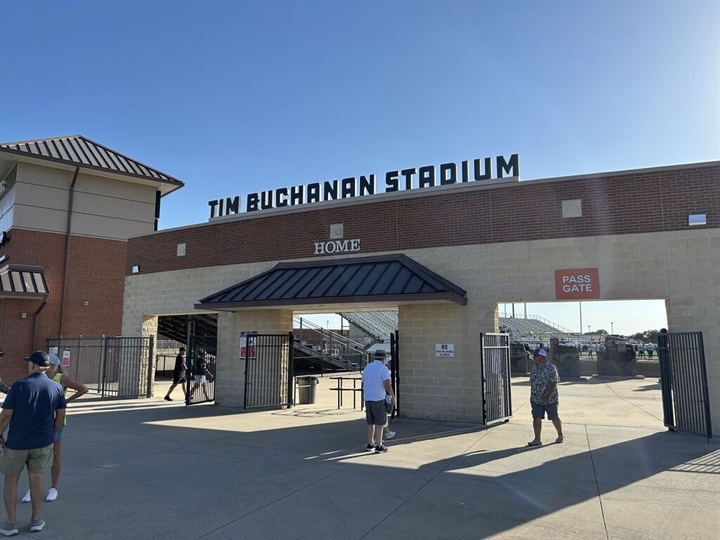
Aledo’s stadium was deemed a hazard zone on Tim Buchanan’s first day on the job, and not for the reasons you’d want as a head coach. It was more dangerous for a fan to watch the game than for any opponent to play against Aledo’s overmatched team. But soon after Buchanan’s last day, that field with the condemned bleachers that poor kids fell through was a mecca of Texas high school football named after its architect.
Tim Buchanan Stadium is a shrine for Aledo’s numerous state records – 12 state championships, 135 consecutive district wins and counting. And now, the house that Buchanan and so many others built will embark upon its final test: 6A football. Because no matter how many trophies these Bearcats stack, the rest of the state has always had one trump card… until now.
“Any time you win the state championship in 5A football, what do the 6A teams say? They go, ‘Yeah, but you couldn’t do that in 6A,’” said Matt Bishop, a three-time state champion as Aledo’s quarterback from 2009-11. “It’s cool to no longer have people be able to doubt you.”
But before you ask whether Aledo is ready for the state’s largest classification – the big dogs, the juggernauts – you must remember where these Bearcats came from. This is the tale of Texas high school football’s greatest dynasty. And what comes next.
Frankly, those shabby stands were a fitting metaphor for Aledo’s football program in 1993. The Bearcats were a salty 1A program in the 1970s, reaching the state championship game in 1974. But that budding small-town dynasty had ended with the arrival of General Dynamics – now known as Lockheed Martin, which moved its headquarters to Willow Park, just north of town.
“They went from 1A to 3A nearly overnight,” Buchanan said. “But the kids that were moving in at that time weren’t the old farm boys that they’d had. They got kids coming to school with horn-rimmed glasses and pocket protectors.”
Aledo struggled mightily in the higher classification. The administration started firing coaches, frantically searching for answers. Buchanan was the sixth head coach in five years. Chuck Curtis was canned despite making the playoffs in 1986 and 1987 because he was hiring coaches whose sons were stud athletes, thereby pushing homegrown Aledo kids down the depth chart. One coach quit after two days because the chairman of the selection committee had promised him he could hire four coaches of his own, but the principal disagreed.
Everybody feared an axe that would swing down quickly and randomly. That first day on the job, Buchanan went to administer an Aledo baseball game. When the seventh inning ended – and Aledo took another loss – an older lady began berating the officials. Her screaming was so aggressive that Buchanan had to act as a human shield between her and the officials, who were attempting to flee in their car.
“Ma’am, you cannot act like this; you’re going to get us in trouble,” Buchanan said. “They’re going to disband our baseball team!"
“Well, my son is the assistant head coach, and he’s going to get fired if we don’t win some games,” she said.
“Well, your son is going to get fired if you ever act like this again!”
Aledo’s calling-card was no longer toughness or discipline, but dysfunction. Billy Mathis, a freshman when Buchanan was hired, said the only offseason he’d ever known was a couple of assistant coaches making the kids run some laps while they waited for a new head coach to come. What else could they do? The school had only one barbell, which was shared among grades 7-12.
“I can remember being in the eighth-grade offseason with me and my buddies Jim Garrison and Robert Ray,” Mathis said. “I’m on the incline bench press, they’re hanging off the end of the bar, and I’m trying to lift them up. That’s the bull crap that we were doing.”
The Bearcats reaped what they sowed on the field. Buchanan watched film of the season before and couldn’t believe what he saw.
“They gave up a touchdown the first time the opponent touched the ball in both scrimmages and all 10 games,” Buchanan said. “It was either the kickoff or punt return, an interception returned for a pick-six, or the first play from scrimmage.”
The most glaring example was the Holliday scrimmage. In most TXHSFB scrimmages, the offense gets an automatic 10 plays to run through their script. But if the defense stops them on downs, the offense has to reset to the 35-yard-line. Holliday scored 10 consecutive 65-yard touchdowns.
Buchanan needed to get to work, and he needed a star-studded staff with him. But everywhere he looked, he struck out.
“They told me I could hire four coaches,” Buchanan said. “Hell, I couldn’t get anybody to come!”
He asked his best friend, Mark Cunningham, to be the defensive coordinator.
“Tim, I’m sorry, but they’re going to fire you,” Cunningham said. “You won’t be there but a year.”
Then he tried Rob Wilcox, a brilliant offensive mind he’d worked with at The Colony, and John Wilson, a college buddy from Abilene Christian who was out in Lufkin. Both said the same thing.
“You can’t win there.”
So, Buchanan was in the deep end with no life raft. Whether he sank or swam was all on him. He examined the giant 1,900-square-foot locker room, donning his freshman-year architecture major hat again. Once upon a time he’d dreamed of building houses. Now, he was about to build a high school football program. He put up a cinderblock wall to convert the locker room into a 12x20 cubby, then converted the rest of the space into a weight room.
Aledo’s team motto that first season was ‘Start on Time.’ Buchanan would sit in front of the fieldhouse every day and chew out kids as they hustled into the locker room. Everyone had five minutes from when the bell rang to get into the fieldhouse. It didn’t matter if you were coming from across the school. Once that five-minute timer dinged, Buchanan locked everyone out.
The first year was rough. Aledo had 17 varsity football players on the roster and went 2-8, scoring just 6.9 points per game. That was the last losing season Aledo has ever had. The team got better year after year as they started stacking offseasons in Buchanan’s program – and realized he wasn’t going to abandon them like every other coach had.
“You loved him. You didn’t want to disappoint him,” Mathis said. “You wanted to play hard for him. Once two-a-days came around, you were dog tired for that second practice. But, by God, you weren’t going to disappoint Coach Buc. He made you feel like you were Superman.”
After back-to-back 6-3-1 seasons in which they narrowly missed the playoffs, Aledo started making the deep runs Texas high school football fans are used to today. The Bearcats made the quarterfinals in 1996, then the semis in 1997.
Given Aledo’s historic success over the past three decades, it’s easy to forget that that 1997 state semifinal run was supposed to be the best season the Bearcats would ever have. The graduating seniors had five kids on the squad whose fathers were starters on the 1974 state championship team. It was a storybook year, a legacy fulfilled, and it was supposed to be the final chapter.
“That senior class (in 1997) was amazing,” said Blake Christenson, a sophomore on the 1998 state championship team. “They were the best class that had ever come through. But it was supposed to be, ‘They just graduated the best senior class of all time; what are they going to do?’ And, this is a typical Coach Buc deal, he came out that year and was like, ‘We’re not rebuilding, we’re reloading.’ And we believed it.”
Aledo was picked last in the district for the 1998 season in Dave Campbell’s Texas Football magazine. The Bearcats were graduating 20 of 22 starters, and Buchanan was unsure if one of those returnees would even play again after a torn ACL in Week 15. Seven of the starters on the 1998 team had played JV football as juniors. Buchanan was the only coach on the entire staff, from high school all the way down to 7th grade, who’d been in Aledo’s school district for more than one year.
So, it’s improbable, but entirely fitting, that Aledo won its first of 12 state titles that season. Because in that season, they found the heart and soul of the program that would power them to 11 more.
“The 1998 team was the one who really became what Aledo is known for: kids who are going to hold themselves and their teammates accountable,” Buchanan said. “They all became overachievers.”
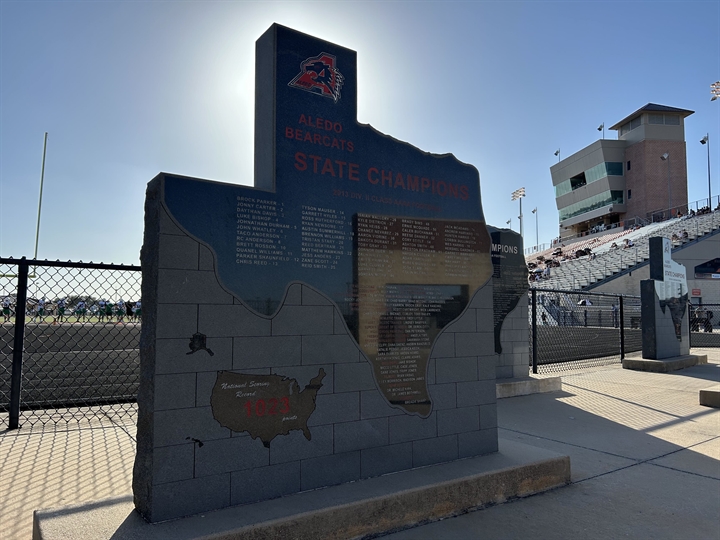
Now, don’t get us wrong, Aledo has had some of the most talented players the state has seen walk through the halls. Former five-star running back Johnathan Gray, the sport’s all-time touchdowns leader, is a prime example. But at its core, Aledo has always worshipped the overachiever. At the end of every season, the Bearcat Award is bestowed upon the member of the senior class who, in essence, did the most with the least amount of God-given talent. That, truly, is what it means to be a Bearcat.
The stories that linger in the locker room about Gray, for instance, are not his state-record eight touchdowns in the championship game against La Marque in 2010. He was not only the best player, but the hardest-working player. In a sense, he was the bridge between the first era of Aledo football, which was all scrappy farm boys, and the current era where half the team has a DI offer, the perfect personification of both.
Gray had two shoulder surgeries in high school, after his sophomore and junior seasons. Technically, he wasn’t supposed to participate in Aledo’s offseason program at all. But he showed up every day in a sling, doing lower-body lifts and cheering on his teammates. Buchanan describes him as the type of kid you had to say ‘Whoa,’ to instead of ‘Go’ to. For example, ‘Whoa, whoa, whoa, Johnathan, you’re not supposed to be bench pressing 300 pounds three months after shoulder surgery.’
The Bearcat 400 is the most pivotal offseason workout in Aledo’s program. It’s a 400-meter dash that all players – including the 300-pound linemen – run at the beginning of the offseason. They write their time in an Expo marker over their heart and then run and lift for months with an almost singular goal in mind: to beat that time by the end of the offseason. The best way to describe a 400m dash is that it’s the suckiest race of them all. There is no physical fitness marker you can reach to make it not suck. It is the true test of mind over matter, where your determination to succeed for Aledo football beats out the fire in your legs and the lack of oxygen in your lungs. That’s the moment the champion is made.
The day Gray committed to the University of Texas, he paused his on-camera interviews so he could run the Bearcat 400 with his teammates.
“Johnathan Gray is the hardest-working football player I’ve ever coached,” Buchanan said. “You never had a bad practice when Johnathan Gray was there.”
Of all the legends who’ve donned the ‘A’ on the side of Aledo’s helmet, Gray is the first name that should be mentioned. But the Bishops are the first family of Aledo football. The patriarch, Lee, was a longtime Bearcat offensive line coach, and his three sons combined for 122 wins and seven state championships as starting quarterbacks.
Matt Bishop, the eldest, was Gray’s quarterback for three seasons, compiling a 45-3 record and three state championships. The middle brother, Luke, won two state titles and was the triggerman behind Aledo’s 2013 offense, which scored a state-record 1,023 points. Jake, the youngest, went 46-2 as a starting quarterback with two state titles in 2018 and 2019.
But more than the wins, the Bishop brothers symbolized what made Aledo football unlike any other team in Texas. They were all hyper-athletic, but none were physically imposing. Matt was the biggest at 5-foot-11 and 190 pounds. None of them went on to a storied college career: Matt played sparingly at Tarleton, as did Luke at Hardin-Simmons, and Jake was a scout-team wide receiver at Texas Tech. But that was ok. Because all they’d ever dreamed about was being the starting quarterback for their father’s team. Lee once said, half-jokingly, that the boys never saw a beach until they graduated high school because they spent every summer training for the Friday Night Lights. They were the true embodiment of Bearcats, the kinds of kids who would’ve been great high school football players anywhere, but could only have been a legendary high school football player here.
“A little boy, if he’s anywhere else, does not become what he becomes here,” Bishop said. “That’s the bottom line.”
Billy Mathis has the unique perspective of being a player in the first years under Buchanan, when the Bearcats were still missing the playoffs, and being the defensive coordinator from 2013-17, perhaps the golden age of the sport’s greatest dynasty. The biggest difference he noticed was that the championships of years past had given the players a swagger he and his buddies never had.
“There was this aura about them,” Mathis said. “There was this belief that when you put on that orange and black, when you put that A on the side of your helmet, you’re unstoppable.”
Because when you put on an Aledo uniform, you were no longer some wide-eyed sophomore playing varsity football for the first time. You were Johnathan Gray. You were Matt Bishop.
But there is a Yin and Yang to being an Aledo football player. On one side, there is confidence. On the other side, there’s the fear.
“The fear is a real thing: The fear of not being the group that goes and wins a state championship drives so many of those kids to go be great,” Mathis said. “Nobody wants to be in that group.”
That A on the side of your helmet sometimes feels like it adds 10 pounds. That’s the weight of following Gray, Bishop, Money Parks, JoJo Earle, and Jase McClellan. Because if you fail, you’re letting them down, too. Aledo has a 135-game district winning streak that dates back to 2007 – before anyone on the current roster was even born. It’s admittedly a weird dynamic to simultaneously rise to the level of expectations, all the while feeling as if you’re being crushed by them. It’s hard to explain unless you’ve been in it. The best example Bishop can give you is what it was like watching his brothers play quarterback after him.
“I was more nervous for them than I was when I played, because I didn’t want them to feel like they failed,” Bishop said. “I knew what that would’ve done to me if I didn’t win, like, ‘Oh my God, I failed y’all.’ I didn’t want them to feel that burden.”
Because, at the risk of sounding like a total hardo, what you do on that field, for better or worse, sticks with you for the rest of your life. Being a Bearcat is a part of your identity you cannot shed. Matt Bishop is now a quarterback trainer who holds sessions in the Aledo fieldhouse. He has clients from Dallas to Wichita Falls, even some in Oklahoma. But he takes the most pride in training every Aledo quarterback who’s started over the last decade. This year’s senior class was all part of his 7-on-7 team in sixth grade. During Aledo’s scrimmage against Southlake Carroll Thursday night, he stood next to his brother, Jake, now a quarterback coach, hanging in the balance between mentoring the next generation and living vicariously through them.
“I went to Tarleton,” Bishop said. “If you don’t go DI from here, and you go to a Tarleton or a Hardin-Simmons or any of these smaller DII schools, it’s a step back from what we experienced here. What we experienced here is hard to recreate. We treat our kids so well here. When you go somewhere else, it’s kind of hard to buy back into anything that’s not Aledo.”
Everybody in this life searches for something to be part of that’s bigger than themselves. Some find it in religion, some in a political party. But since 1993, every parent, kid, teacher, and custodian in this town 20 miles west of Fort Worth has found it in a high school football program. According to Steve Wood, himself a legendary Aledo coach who compiled a 75-4 record in five seasons, that’s what made Aledo great. It’s also why he’s conflicted that they named the locker room the Steve Wood Complex, just as Buchanan is iffy about his name being on the stadium. Frankly, he considers himself the lucky one that he was part of it.
“Was there talent? Absolutely, I’m not that naive,” Wood said. “But the commitment was there from everybody. From the community, the coaches, the administration, and from the kids. And it was a one-school town. Everybody’s pulling the same way. And it is right now, but it won’t always be that way.”
For the last 10 years, two rumors have swirled around Aledo, feeding off of each other like a tornado that would blow through the Bearcats program and leave it forever changed. Class 6A football always felt inevitable. That doesn’t scare Aledo. But what does send a chill down everyone’s spine is the thought of a new high school, the idea that this community will be divided, no longer one town and one team.
When Buchanan moved to Aledo in 1993, the town had five of the largest working ranches in North Texas: the Walsh, Dean, Beggs, Veale, and Bear Creek. The superintendent told him if he wanted to keep his job, he needed to post up at the coffee shop. Buchanan would sip coffee in downtown Aledo and watch four Cowboys ride up from the Dean, tie their horses to the fence, and walk across the streets in their chaps and spurs to have a cup of Joe and talk Aledo football with the coach.
Buchanan still lives in the same house he bought in 1999, an acre-and-a-half south of town in Deer Creek. His young kids might as well have thought they lived on Yellowstone Ranch. There was a 15-acre lake to the East where they fished. The Buchanans hunted in their own backyard.
Now, Aledo is North Texas’s next booming suburb.
“When I first moved here, all we had was a two-lane street,” Bishop said. “Now they have a big circle that goes over the railroad tracks. You used to drive, and every other car you’d pass, you knew. Like, ‘Oh, there’s my homeboy’s truck.’”
It’s hard for Buchanan to wax poetic about the old, small-town days. The Aledo football program that he created, which continues to outlast him after retirement, is largely responsible for the growth.
“I’ll just say this: my biggest supporters were home builders, real estate people, and land developers,” Buchanan said. “Aledo does not pay well. We’re a bedroom community. So anytime someone started courting me, trying to get me to leave – and I interviewed at a lot of different places – I’d have developers and homebuilders come and ask me, ‘What does it take to keep you here?’”
Buchanan says he lost every assistant on his staff, down to the middle school coaches, after Aledo’s success in the 1996 season because the pay was so poor. So, around the late 1990s, a group of boosters banded together to form the A Team, which funded staff retreats at the beginning of the season. The more success Aledo had, the more boosters came on. Buchanan says this was the closest he ever came to getting nervous about whether his football team could perform. At one point, he turned to a buddy named Lynn Fairis on the A Team to confide his worry.
“Lynn, this is getting bigger than what I thought,” Buchanan said. “I don’t want these guys to get upset if we have a bad year.”
“Tim, you don’t worry about what these guys are investing in the A team,” Lynn said.
He put his arm around Tim and pointed toward a booster manning the grill, slinging burgers, a big smile plastered on his face.
“That guy has never made more than half a million dollars in development,” Lynn said. “Since you started winning at Aledo, he’s made over $10 million.”
The Aledo Bearcats going to 6A football was not something that happened to them. It was something Aledo did to itself. The bump to the state’s largest classification is the ultimate compliment to Aledo’s success.
But the more people that moved in, and the more state championship trophies that were raised, the more Aledo Nation forgot where this program came from – condemned bleachers and blowout losses – and started taking it all for granted.
“Here’s the mentality of a lot of people in this town,” Bishop said. “You go, ‘Hey, are you going to the Aledo football game tonight?’ And they go, ‘Nah, I’ll go to the semifinal game.’ Or, ‘I’ll go to the state game,’ I’m like, ‘Dude, you don’t know if we’re going to get there.’ But around here, it’s expected.”
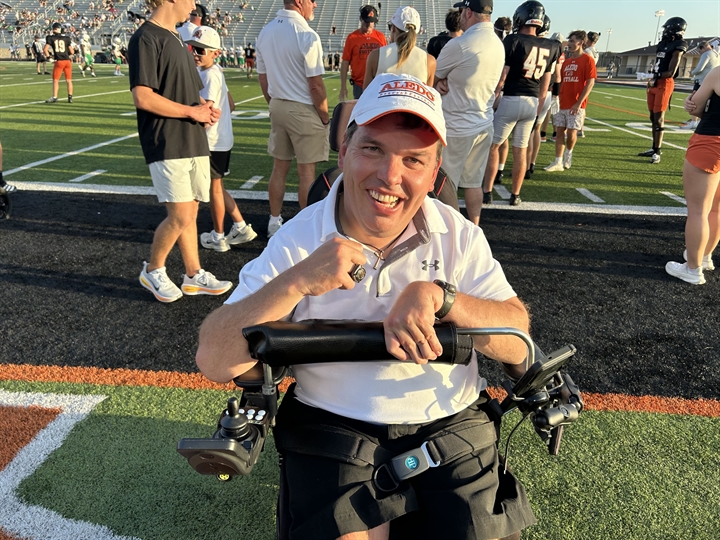
Now, again, Aledo has some of the best fans in Texas. No one better represents their undying love for the Bearcats than Brodie Sharp, a 41-year-old superfan. Sharp was born with cerebral palsy and has been wheelchair-bound his entire life. When he attended Aledo High School in the early 2000s, Coach Buc told him to come out for the football team, and they’d find a spot for him. Sharp was a team manager for four seasons, but he’s never left the sidelines since. Last Thursday’s scrimmage against Southlake Carroll officially kicked off Sharp’s 28th season on the sidelines of Tim Buchanan Stadium. He leads the team out of the tunnel before every game.
The coaching staff gave him a state championship ring with “Sharp” engraved on the side. He’s a critical part of the team, even if he’s never played a down. As Aledo makes yet another tackle behind the line of scrimmage, he’s asked what year his state championship ring is from.
“I can’t remember; I’ve got so many of them,” Sharp said.
Sharp is a one-of-one fan. He will show up for every game like it’s the state championship. But not everyone will; and not everyone has.
Aledo’s seasons are still exciting. But for the last half-decade in 5A, it’s become a little monotonous. The first three games of non-district play are always electric. Not only do you have the energy of football season being back, but Aledo schedules brand-name teams like Denton Guyer, Cedar Hill, and Lancaster. Then come seven games of district play, during which the staff tinkers with the lineup and tests new plays. There’s normally a Denton Ryan on the schedule that’s a dogfight, but overall, it’s a bunch of dress rehearsals for December football. And it’s vital for the staff, but fans have begun questioning whether it’s vital for them.
“I didn’t get tired of the blowouts that we had in our district games, but our fans were kind of tired of that,” Aledo head coach Robby Jones said. “I think our attendance has suffered the last couple of years as a result of that. But now, we’re going to have a ball game every week.”
Nolan Ruth, an Aledo alum who serves as a Parker County insider for GM Sports Media, scanned the stands during the Bearcats’ scrimmage against Southlake Carroll and said he’d never seen so many people show up for a preseason game. This year, for the first time in a long time, Aledo fans will pack the stands every Friday night with a real possibility they’ll file out as losers. And maybe that’s a little scary, but it’s also the reason we love sports.
It’s not fair to say Aledo’s actual team needed a fire lit under them like the fans did. The Bearcats have won 11 of the last 17 state championship games, an absurd feat. But there is a scenario where they benefit from a jump to 6A, too.
These past two seasons were the first time Aledo missed out on AT&T Stadium in back-to-back years. Last season was especially painful. The Bearcats were one quarter away from Arlington – until 28 unanswered points by Frisco Lone Star in the fourth quarter sent them home. The worst part was that Aledo couldn’t chalk it up to a mistake they made or a ball that bounced the wrong way. They simply ran out of gas. They were outworked. They were beaten in all the things they prided themself on. That state semifinal game – Week 15 of the season – was the fourth time all year Aledo had played their starters in the fourth quarter. In every other game, the win was sealed by halftime.
“Our guys got tired,” Jones said. “They weren’t used to playing four quarters. Give all the credit in the world to Lone Star. They were able to be in the game until they got us tired and took it over.”
Maybe this entire program needed a return to its roots, to remember that it came from nothing, to be put in a position where they needed to prove everything. In that sense, 6A football couldn’t come at a better time. And everyone who interviewed for this article said there was no better man to lead Aledo into the final frontier than Robby Jones.
One of the many open secrets to Aledo’s success is that no matter how much the surrounding town changes, the program stays the same. Jones is the perfect example. He was hired as a middle school coach in 2001 and was elevated to offensive coordinator in 2009, where he called plays for the best offense in state history. He may only be entering his fourth year as Aledo’s head football coach, but he’s one of two people (current offensive line coach Doug Wheeler) who have been part of 11 of Aledo’s state championships. More than Tim Buchanan. More than Steve Wood.
“That’s the reason I got upset when we started putting names on the stadiums, like the Steve Wood Complex and Tim Buchanan Stadium,” Buchanan said. “I asked (Aledo Superintendent) Dr. Bohn, ‘What are we going to do for Robby? Before it’s all said and done, Robby is going to have more than any of us!’”
So, when Aledo kicks off its run in Class 6A this fall, Buchanan will sit in those same stands that had yellow caution tape wrapped around them on his first day, packed next to fans from across the state who are watching on the edge of their seats to see whether the house they all built can withstand the force of the state’s largest classification. Except the difference is that Buchanan won’t be waiting with bated breath, but with the knowledge that the best is yet to come.
This article is available to our Digital Subscribers.
Click "Subscribe Now" to see a list of subscription offers.
Already a Subscriber? Sign In to access this content.
 Don't Miss Any Exclusive Coverage!