




EL PASO – It’s 4:00 a.m. in Ciudad Juárez, Mexico, when Azhiel Rodan’s phone alarm blares. He wipes the crust from his eye, dazed and confused that Monday morning came so soon. The weekends he spends across the border with his mother are always too short.
This past Friday, Azhiel’s football team at the El Paso Leadership Academy had an away game at Whiteface, a town just west of Lubbock. The team bus didn’t get back to the school until 4:30 a.m. Then, Azhiel still had to cross the Bridge of the Americas – known locally as the Puente Libre – an international port of entry from the United States to Mexico.
Azhiel had tried sneaking away from the team to hike to the bridge alone, not wanting to bother anybody. But his coach insisted he get in the car, already knowing where he was heading.
He’d spent 15 hours round trip on the bus to play the football game, but the journey was far from over. His mother’s house in Ciudad Juárez is an hour away from that bridge. By the time he stumbled through the front door and plopped on his bed, finally home from his Texas high school football game, the Saturday morning sun was shining through his bedroom window.
He felt like he’d blinked, and now it was time to go back to the United States for another week of school.
Azhiel is a dual citizen, which allows him to cross back and forth over the border. He grew up in Ciudad Juárez with his mother. But three years ago, she started sending him to live with his uncle, a legal guardian, in El Paso so he could attend the El Paso Leadership Academy, a tuition-free charter school.
But attending still comes at a cost. Azhiel didn’t speak any English before he enrolled, and he had to live away from his mother from Monday to Friday. She was only an hour away, but in a foreign country.
Every time Azhiel wants to quit, he thinks about all his mom is sacrificing so he can get a high school diploma in the United States.
“My mom really had a hard life,” Azhiel said. “She lost my dad-presence. He died when I was like six months old. For her, it’s been really hard. But she always tried to give us opportunities and never gave up.”
Azhiel is still thinking about her as he crosses the international bridge. It only takes about three minutes to walk across, depending on the customs line, which is weird because this act is such a massive leap of faith that all this lack of sleep and time spent away from family will be worth it in the end.

The sound of skirting tires pulls him back to the present moment. Coach Andrew Hernandez is here to drive him the rest of the way to school. Hernandez’s official title is head coach and athletic director at El Paso Leadership Academy. But carpool coordinator is one of his many unofficial duties. To get all of those different jobs done, which aren’t on his job description but will result in the program falling apart if he doesn’t complete them, Hernandez is also up hours before sunrise, his first win of the day in a never-ending competition with time.
If Hernandez had an Oura Ring, or one of those other body batteries, his app would be screaming at him for a poor sleep score, pleading with him to take a recovery day. High school football coaches have an inherently skewed work-life balance. But Hernandez has always considered coaching El Paso Leadership Academy’s six-man football team his life’s work. So he’s never off the clock, from the moment he wakes up at 5:00 a.m. to when he races home just before his three-year-old son’s bedtime at 8:00 p.m. to kiss him goodnight.
But his boy has to go to bed without him on more nights than Hernandez would like to admit, like this past Friday against Whiteface. As a six-man football team with no home stadium in El Paso – nine hours away from most metropolitan areas like Dallas, Austin, and Houston – ELPA has to schedule the games that no other program would even consider.
Frankly, the coaches might not have considered that game had they known how long it would take. Really, the ride to Whiteface should’ve been four hours. But the team school bus, which Hernandez affectionately dubs the “Cheddar Wagon”, couldn’t handle the Guadalupe Peak terrain that comes with the shortcut through New Mexico. So they had to take the long way through Pecos and Andrews.
The El Paso Leadership Academy does everything the long way, which makes its state championship in the Texas Christian Athletic League last season that much more remarkable. The charter school, which opened five years ago, charges zero tuition and does not take property tax funding like other public schools in the El Paso Independent School District. Really, the only money keeping it afloat is federal and state funding on a per-student basis. But the school is tiny by design. Its mission is to know every student by face and name. About 570 kids are in grades 6-12 combined.
Given the lack of funds, the school has no athletic department budget. Hernandez receives a stipend, but all of that money goes back into the program. In the first years, he divided that stipend among his assistant coaches, who weren’t getting paid. He purchased the first 15 helmets and every set of shoulder pads the program has with his own paychecks. When that money ran out, he turned to flipping ice cream sandwich bars from a refrigerator in his classroom – buying a 12-pack at Walmart for $2.97, then selling each for $1 to middle schoolers after lunch, making a $9 profit.
So that 15-hour round-trip drive is a small price to pay given what Hernandez has already invested. And while his assistant coaches told him last night during film study that they were all sick from the journey and taking NyQuil to knock themselves out, he has no dark circles under his eyes as he leans into the backseat to give Azhiel a fist bump. He’s chipper and talkative, as if the sun inching over the El Paso horizon painting the Franklin Mountains with a warm orange hue is his morning coffee. Frankly, he’s used to running on three hours of sleep, both from his insane time commitment to this program and the hours he spends staring at the ceiling next to his slumbering wife, wondering what more he could do with the time tomorrow.
“My day is hard,” Hernandez says. “But it’s not as hard as these kids.”
Two types of kids attend El Paso Leadership Academy. Some are running from something. They attended an El Paso Independent School District campus but were headed to an alternative school after multiple disciplinary violations. So, their parents pulled them out of EPISD and sent them to El Paso Leadership Academy, where the faculty could keep a closer eye on them.
“I was the principal of an alternative campus,” ELPA Principal Daniel Montoya said. “That’s where the student has broken the school code of conduct so many times that you send them off to a different campus. Well, all they do there is socialize with the kids who are breaking rules in other schools. Then, they build these networks of bad influences.”
Then, there are the kids, like Azhiel, who are chasing something. They were born in Ciudad Juárez and don’t speak any English. Their parents have sent them to live with a legal guardian in El Paso – an uncle, a cousin, or even a sibling – so they can get an American education and learn English.
Whether they’re running from something or in pursuit of something greater, these students are lost, and they find a home at the El Paso Leadership Academy.
Long before ELPA opened, Principal Montoya was one of those kids who would’ve benefitted from it. His parents lived in Ciudad Juárez and sent him to live with a host family during the week. Originally, he planned to go back to Mexico after high school, where his bilingual ability would earn him a higher wage at the Maquiladoras, US-owned factories in Mexican border towns like Ciudad Juárez. Instead, he enlisted in the Air Force, then worked in education, hoping to guide the next young kid like himself.
Because, the truth is, a lot of these kids feel the same strong pull to return to Mexico that he did. If a student gets a job at Sonic, they are already making more than their parents make in Ciudad Juárez. One of the most important facets of Montoya’s job is helping kids realize the bigger picture – that a high school diploma is the only way to provide long term security for their families.
“Once they see that quick money, they’re not going to come back,” Montoya said. “So (we’re in a predicament) where, if we don’t let them go, he doesn’t get to pay bills at home. But if we let them go, we run the risk of him not coming back and picking up a full-time job, forever.”
Of course, this arrangement raises questions about residency requirements. Montoya fields them all the time – accusations that he lets anyone into the school. ELPA requires students to reside in its service area, and some students who have family in Ciudad Juárez live during the school week with legal guardians in El Paso. The school has turned away students who cannot meet those residency requirements.
Recently, a family lived in Michigan, but the father was deported and settled in Ciudad Juárez with his family. The mother, wanting to keep her family together, tried to send her daughter to ELPA while still living in Mexico. The school could not accept her unless she had a legal guardian residing in the United States.
“Even the schools in El Paso ISD, they can’t ask for your citizenship,” Montoya said. “Any student that comes across that door, you go to take them in and educate them. Now, if we have an indicator that they don’t live in the US, then we go out and do home visits and make sure they’re living in El Paso County.”
For many of these families, the path to ELPA is narrow. But desperate families will tread it if it means giving their child a better life than they had.
“We hear about the American dream,” Montoya said. “Well, they hear that across the border, too.”

This past Saturday, on a rare day off, Coach Hernandez went to UTEP’s home opener against Texas Southern. UTEP’s stadium, ‘The Sun Bowl,’ is nestled in the foothills of the Franklin Mountains. From the parking lot, at an elevation of over 3,000 feet, you can gaze directly into Ciudad Juárez. One highway splits these two cities.
“You are born into a family, and it’s basically the lottery,” Coach Hernandez said. “We don’t get to choose our parents or where they live.”
And in the past couple of years, Hernandez has thought more and more about why he was born in the United States and what his purpose is here.
His father was a first-generation US citizen, born in Ciudad Juárez before attending high school at El Paso Riverside. Growing up, he was stern towards Andrew, an admitted mama’s boy as the youngest son. He was the type of dad who would change a tire, take it off, then have Andrew do it again. It was his way of teaching his young boy, who knew nothing other than the United States, that you had to earn everything in this life.
Hernandez knew his father became a US citizen as a child. But his dad always hid the struggles of his past from his children, instead immersing himself fully in supporting their lives. He was in the stands for every one of Hernandez’s games when he became a running back at El Paso Franklin High School.
“I’m the richest poor person you’ll know,” Hernandez said. “I lived a life where I knew I wasn’t rich, but richness to me is the happiness [my father] brought to me. I’m a reflection of the hard work he’s always done.”
But about five years ago, his wife asked him what his father’s story was, and Hernandez was ashamed to say he didn’t really know. He had only heard the whispers. So he called his dad at 11:00 p.m. and asked that he tell him everything. That’s when he learned about the struggle and sacrifice required for him to have the childhood he’d enjoyed.
That conversation, in many ways, was the origin story for his work at El Paso Leadership Academy. Because in these young men he pictures his father, and he hopes one day they’ll grow up to have families of their own. He knows the time he invests in each kid will ripple through generations, because he is an example of someone who benefited from the sacrifice these kids are making.
But a second force also drives Hernandez: guilt. He feels he has a debt to settle in this world for taking advantage of a struggle he wasn’t thankful for and didn’t even understand for the longest time.
“When you really talk to a kid, sit down with them and ask, ‘What’s tough to you?’ It’s, ‘Well, I might not have food later. I might not have a parent that tells me I love you,’” Hernandez said. “It’s the simple things that we have in life that I feel like I’ve taken advantage of my whole life, because I didn’t know that my dad went through that.”
So every day he pours more of himself into the program, chasing his father’s legacy even though he says he’ll never become the man his dad is. ELPA has no athletic facilities, so Hernandez raised funds for a weight room in the classroom across the hall. His football players lift there before school starts, then go to school in the same clothes without showering. He created a makeshift locker room in an upstairs classroom, putting the backs of chairs up against desks in place of actual lockers.
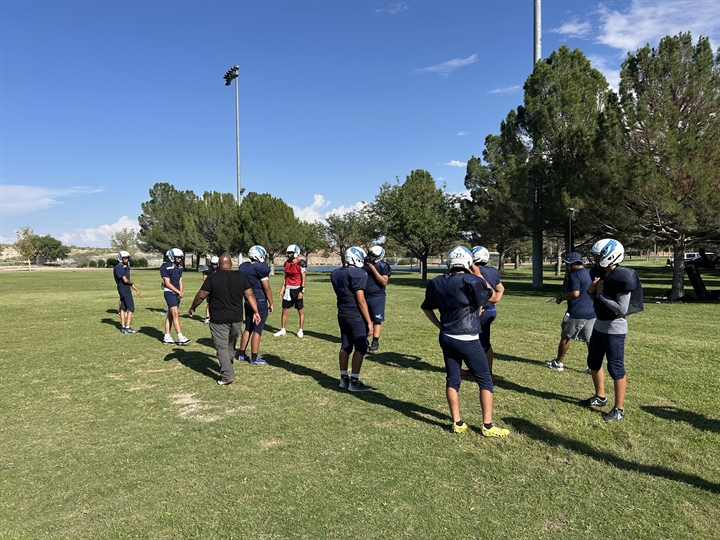
ELPA doesn’t even have a field at their school to practice on. They used to practice in a rocky swamp cordoned off by a chain-link fence behind the school. But the pebbles wore the kids’ cleats down to nubs and cut their arms when they were tackled onto the sharp edges. Now, the team takes a bus to a nearby public park every afternoon to practice.

Some people scoff at this arrangement. Hernandez had one kid transfer into the school from El Paso Americas, but he quit the team the moment he saw the classroom/locker room, saying this wasn’t a football program. Before the season, ELPA participated in a photoshoot with other area teams. Some of the kids from other schools roasted the ELPA players for not having the brand-new Revolution Speed Flexes their school had.
But the actual players at ELPA never complain. In fact, they’re effusive in their thanks. Where an outsider sees barriers, they only see opportunity. A seven-hour bus ride for a game is unfathomable to 99 percent of this state. But these kids have never been outside of El Paso, so they sit with their faces pressed against the window the entire way.
“Where are we, Mister?” they ask.
“Dallas,” Hernandez says.
“Oh, I’ve always heard of this place,” they say. “Isn’t this where the Cowboys play?”
But Hernandez, now 40 years old, has perspective on what the rest of the state has that these kids don’t.
Texas high school football is famous for its facilities, constantly propped up on a nationwide scale for the outsized importance they place on this game. Throughout the day, he quizzes me about the schools I’ve visited for my job. When he finds out I was part of an Austin Westlake game broadcast last week, he says he’d build a powerhouse if he had 1/16th of their budget. When he realizes I’m from Frisco, he asks if Lone Star, the team that made the state championship last fall, has restaurants in their cafeterias.
During one of his off periods, we drive to the Socorro ISD Student Activities Complex, which holds two stadiums with electronic video boards and wrap-around stands. He looks longingly inside, stating his ultimate goal is for ELPA to grow into an 11-man football team that plays here.
But there’s another side of Hernandez that relishes the challenges ELPA faces. He considers himself a lifelong underdog. He struggled in school because of ADHD, the only hints of which now come when he gets excited talking about his program and bounces around different topics mid-sentence, his brain moving faster than his mouth can describe. At 5-foot-7, he was always passed up on El Paso Franklin’s depth chart in high school, only getting a chance when the starting running back got injured his senior year, and he broke the school’s single-game rushing record in his first start. After tearing both of his pectoral muscles, he went to PIMA Junior College in Arizona without a scholarship, then walked on at the University of Arizona.
So he wonders: if he were really granted all the facilities he wants, would he still work as hard? Or would he lose all this drive if he was given everything? He likes to think he wouldn’t, that he’d still be the same guy. But, frankly, his work ethic comes from seeing how thankful his kids are even when they’re given next to nothing. The quest to give them everything gets him out of bed every morning. Maybe these other schools have actual lockers and a full-sized weight room, but they don’t have the heart his kids do.
“It’s a different type of kid here,” Hernandez said. “I’ve been at other ISDs, and this is the most fulfilling. I don’t think I’d be a coach if I wasn’t here, honestly. Every day, I have a smile on my face.”
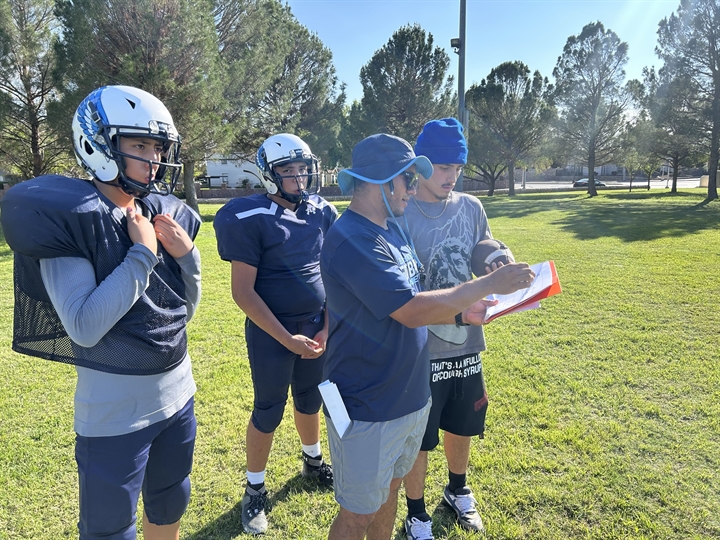
His assistant coaches feel a similar pull.
Josue Contreras is a 30-year-old assistant coach who still looks like he could play Division I football. Because ELPA is short four defensive starters due to injury, Coach Contreras hops in as a scout team quarterback so they have enough bodies for a full practice. He sprints left, jukes, and chucks the ball downfield, all the while coaching the defense throughout the play.
Other El Paso-area programs have noticed his energy. This offseason, he was offered two different coaching positions at District 1-5A DII schools. It should’ve been a no-brainer to accept. Contreras is not paid for his role on the ELPA football team. He’s a young guy with dreams of starting a family. But he couldn’t leave this team. Contreras has a calling here, something worth far more than money.
“It is enticing, I’m not going to lie,” Contreras said. “Eleven-man football is my first love; that’s what I grew up with. But I have a love for this team as well. I have a few seniors coming back from last year’s team. I think I owe it to them to be there for them and give it my best effort and make sure we finish what we started strong.”
The coaches interviewed for this story are all realists. They know they can’t stay at ELPA forever. This work-life balance, especially with the lack of pay, is just not sustainable. But this program needs to get to a point where it can exist without them. And until that happens, they won’t leave. Some of these kids have fathers in prison. Some have been kicked out of other schools. And the kids will never tell them that, partly because they don’t want to be defined by it, and partly because they’ve been wrongly convinced they’re a burden. They all come from different backgrounds, but at some point or another, they’ve all been abandoned. And these coaches will be damned if they abandon them, too.
“I just feel like if I left, it’d be something I left incomplete,” Contreras said. “I want to finish it.”
This Saturday, ELPA could cement themselves on the statewide scene, something this program has been working tirelessly towards for three years. ELPA has a home game against Strawn, a six-man football blue blood program with five state championships. The game will be broadcast on EP Sports Network’s YouTube page, a showcase for ELPA’s football program.
It’s a full-circle moment for Coach Hernandez. He originally learned about six-man football by watching “Texas 6,” a documentary about the Strawn football team. Coach Dewaine Lee and his Greyhounds are the class of the state. No one gives ELPA a chance. Strawn is a 28-point favorite. But that’s nothing ELPA isn’t used to. At every moment, they’ve been counted out. And yet, on Saturday, they’ll line up against one of the best football teams in the state, knowing that everything they’ve already overcome has prepared them to beat the odds… again.
“I feel like people write them off a lot, and I think the kids thrive off that,” Contreras said. “To put things into perspective, a lot of these kids wake up at 4:00 a.m. in Juárez. Football’s probably not the hardest thing in their life.”
This article is available to our Digital Subscribers.
Click "Subscribe Now" to see a list of subscription offers.
Already a Subscriber? Sign In to access this content.
 Don't Miss Any Exclusive Coverage!